Poilievre Says Canada Will Not Become the EU’s ‘28th State’
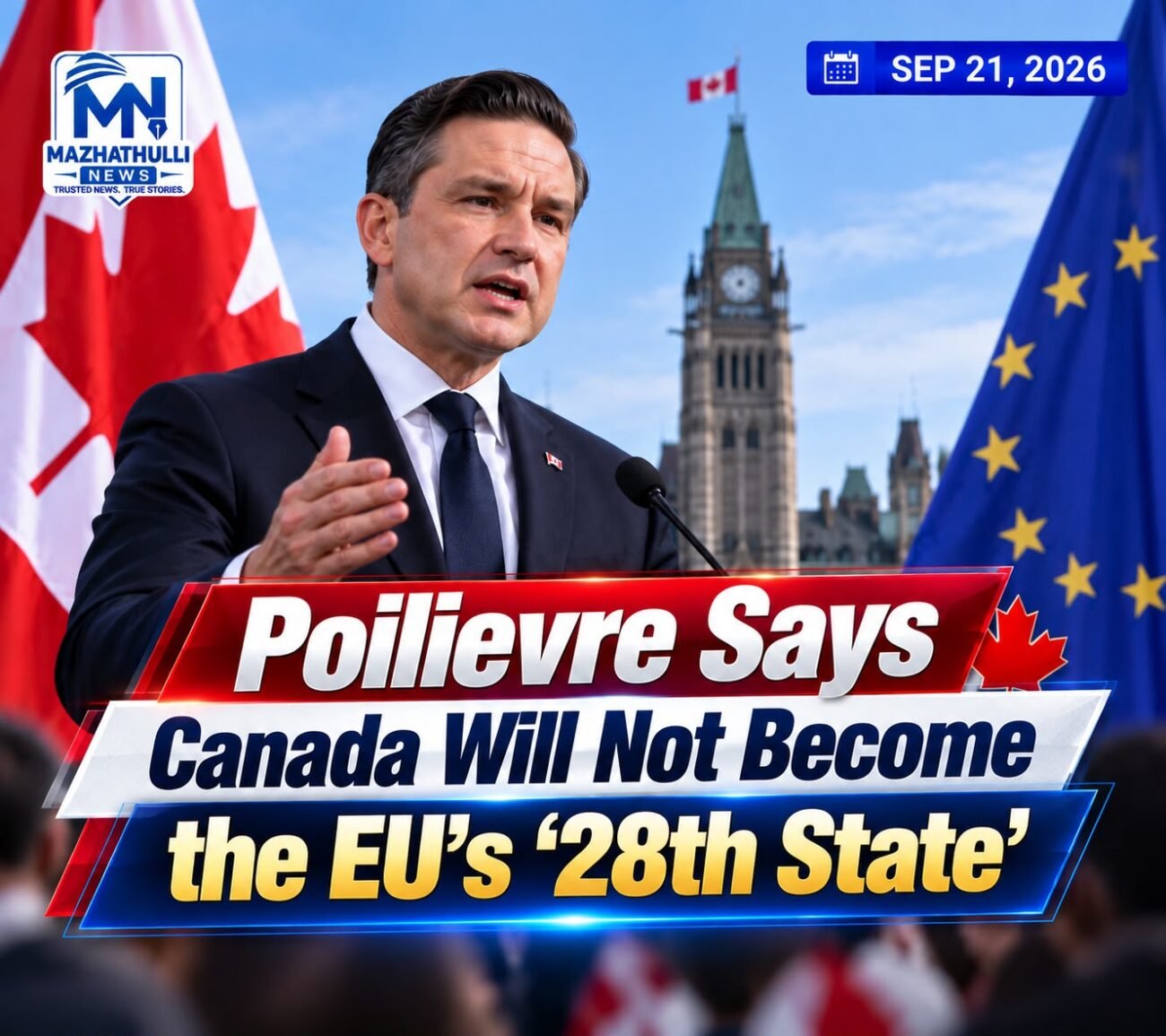
Conservative Leader Pierre Poilievre says Canada will “never be the 28th state of the European Union,” as Prime Minister Mark Carney’s government moves toward deeper economic, security and strategic ties with Europe.
Poilievre made the remarks Sunday at a Conservative rally in Brantford, Ontario, just days after European Commission President Ursula von der Leyen proposed that Canada become the European Union’s first “associate member.” The proposal is unprecedented, as the EU currently has no formal category for associate membership.
Poilievre said Canada already has a free-trade agreement with Europe and maintains close defence relationships through NATO. He argued that closer cooperation should not result in European taxes, laws or regulations being applied in Canada. He also said decisions affecting Canada should be made by Canadians rather than by institutions in Brussels, Washington or Beijing.
The Conservative leader has framed the issue around Canadian sovereignty and domestic decision-making, while also criticizing the possibility of increased European influence over Canadian policies. His comments come as the Conservatives prepare for the return of Parliament and seek to challenge the Liberal government’s approach to international trade and economic policy.
Carney, meanwhile, has welcomed the European Commission’s proposal and said Canada is interested in developing a significantly closer relationship with the EU. The prime minister has stressed that Canada is not seeking full membership in the European Union, but has expressed support for exploring a new form of partnership.
The proposed relationship could cover a wide range of areas. Carney has highlighted opportunities for young Canadians to study and work in Europe, closer cooperation in financial services, critical minerals, defence, artificial intelligence, energy, space and digital trade. The two sides have also discussed strengthening economic and security cooperation as Canada looks to diversify its international relationships.
The EU and Canada already have a major trade relationship through the Comprehensive Economic and Trade Agreement, or CETA. The new proposal would seek to expand cooperation beyond traditional trade arrangements into areas such as defence and technology.
However, the details of “associate membership” remain unclear. The EU has never previously created such a membership category, and there is no established framework defining what rights, obligations or access it would provide. European officials and analysts have also noted that the eventual arrangement could consist of a series of agreements and participation in existing European programs rather than formal EU membership.
Carney has said the proposed partnership would be brought before the House of Commons for debate and a vote. That means any significant new arrangement would ultimately be subject to political and parliamentary scrutiny in Canada.
The discussion is unfolding amid continuing trade tensions between Canada and the United States. Ottawa has been looking to strengthen relationships with other major economies while maintaining its existing ties with Washington. European leaders have similarly described Canada as an important partner in areas ranging from trade and energy to defence and critical minerals.
For now, there is no proposal for Canada to become a full member of the European Union or to surrender its sovereignty to EU institutions. The central issue under discussion is whether Canada and the EU should establish a new, deeper form of partnership and what the practical terms of that relationship would be.