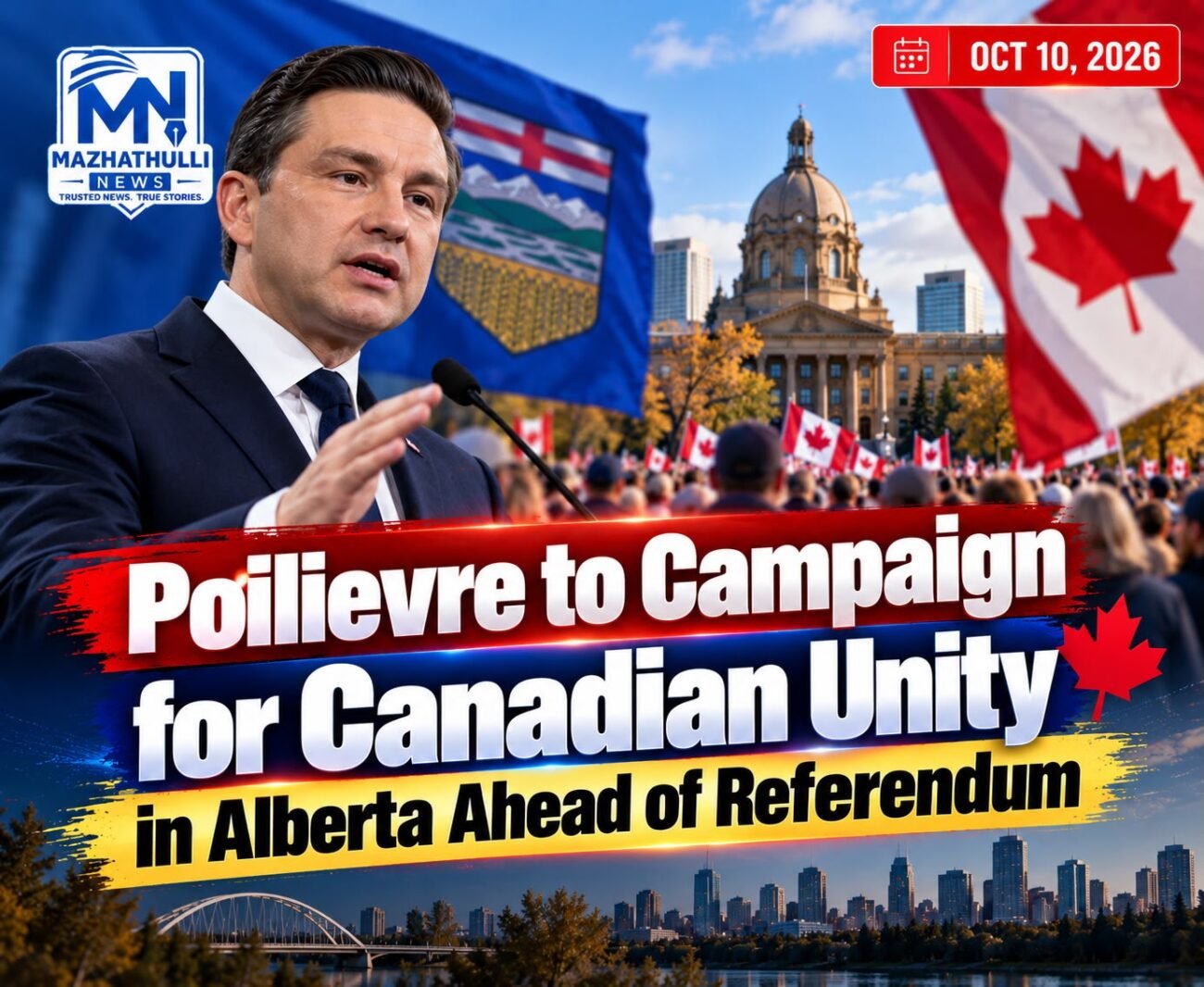
Poilievre to Campaign for Canadian Unity in Alberta Ahead of Referendum
Conservative Party of Canada Leader Pierre Poilievre is set to campaign for Canadian unity in Alberta next week, ahead of a referendum that could shape the province’s political relationship with the rest of the country. Poilievre’s planned visit comes as Alberta prepares for an October 19 vote on whether the provincial government should begin the process toward another binding referendum on separation from Canada. The issue has gained prominence amid growing debate over provincial autonomy, federal policies and Alberta’s economic future. The upcoming vote is not a direct referendum on independence. Instead, voters will be asked whether the provincial government should take steps toward holding a future referendum on whether Alberta should leave Canada. A vote in favour would not automatically separate the province from the federation. Poilievre’s campaign for national unity is expected to focus on keeping Alberta within Canada while addressing the concerns that have fuelled separatist sentiment in the province. These include disputes over energy development, federal environmental policies, taxation, economic decision-making and the distribution of powers between Ottawa and provincial governments. Alberta has long been a centre of debate over federal-provincial relations, particularly because of its oil and gas industry. Many Albertans have argued that federal policies have placed unnecessary restrictions on the province’s energy sector and limited its ability to develop its natural resources. Separatist groups have used these concerns to build support for greater provincial independence, arguing that Alberta would have more control over its economy and political decisions outside the Canadian federation. Supporters of Canadian unity, however, argue that Alberta can pursue its economic interests and demand changes to federal policies without leaving Canada. They point to the province’s access to the national market, federal institutions and interprovincial economic relationships as important considerations in the debate. Poilievre’s visit also comes at a politically significant time for the federal Conservative leader. Alberta is a major source of support for his party, and the separation debate presents an opportunity to outline how a Conservative federal government would address western Canadian concerns while maintaining national unity. The Conservative leader has previously criticised federal policies affecting Alberta’s energy industry and called for greater economic freedom for provinces. His position on national unity places him in a delicate political situation: he must acknowledge frustration with Ottawa while arguing that separation is not the answer. The referendum campaign has also prompted discussion about the legal and constitutional steps that would be required for Alberta to become independent. Even if a future referendum produced a majority in favour of separation, independence would not occur automatically. Negotiations with the federal government and other constitutional questions would remain. Alberta’s political debate has attracted attention beyond the province, with national leaders and commentators discussing the possible consequences of separatist sentiment for Canada’s economy and political stability. For Alberta residents, the October 19 vote will determine whether the provincial government receives support to begin a process toward a future separation referendum. It will not, by itself, decide whether Alberta leaves Canada. Poilievre’s planned campaign for unity is expected to add another prominent voice to the debate as the vote approaches. His message will be closely watched by voters who support remaining in Canada but want changes to federal policies, as well as those who believe the province should consider a different constitutional future. With the referendum approaching, the central question remains whether Alberta’s grievances can be addressed through political and economic reforms within Canada or whether support for a future separation vote will continue to grow.