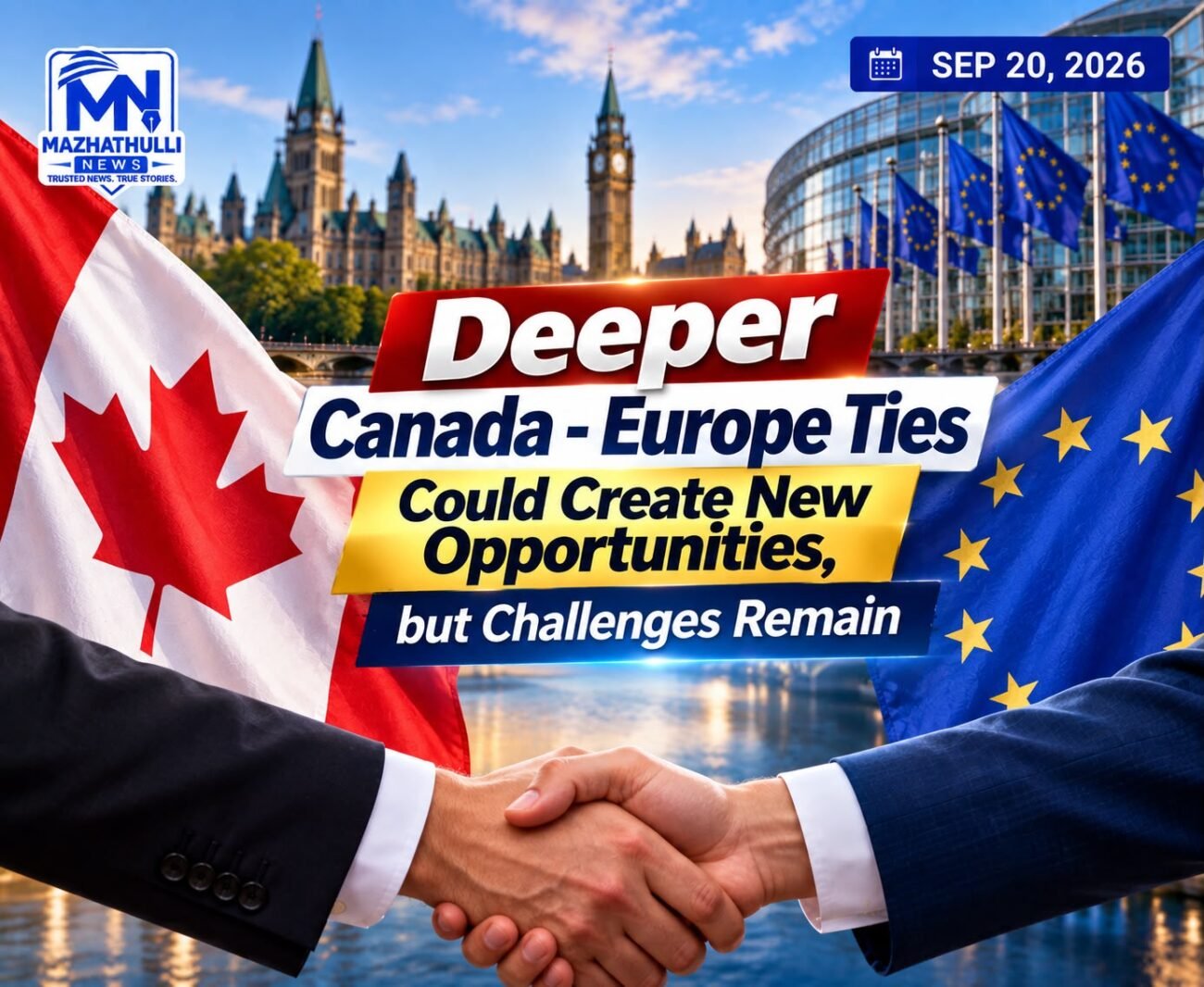
Deeper Canada – Europe Ties Could Create New Opportunities, but Challenges Remain
Canada’s push to strengthen economic, trade and security ties with Europe could create new opportunities for Canadian businesses and workers, but the proposed deeper partnership also faces legal, economic and political challenges.
Prime Minister Mark Carney used his recent address to the European Parliament to call for a significantly deeper Canada–European Union relationship. He proposed cooperation in areas including critical minerals, defence, artificial intelligence, energy, space, financial services and digital trade.
The European Union has also signalled its interest in taking the relationship beyond the existing Canada–EU Comprehensive Economic and Trade Agreement, or CETA. European Commission President Ursula von der Leyen proposed opening discussions on making Canada the EU’s first “associate member,” although the details and legal framework for such a status have yet to be established.
For Canada, closer ties with Europe could provide opportunities to diversify trade and investment. The EU is already Canada’s second-largest trading partner for goods and services, with bilateral trade valued at approximately $178 billion in 2025, according to the Canadian government. Canada could also gain greater access to European markets, research networks and industrial supply chains.
Critical minerals are another area where the two sides could benefit from closer cooperation. Canada has significant supplies of minerals considered important for batteries, clean-energy technologies and advanced manufacturing, while Europe has major industrial and research capabilities. Closer coordination could strengthen supply chains and create opportunities for Canadian producers and European manufacturers.
Defence cooperation is also expanding. Canada became the first non-European country to join the EU’s Security Action for Europe initiative, known as SAFE, in 2026. Ottawa has said the arrangement could create opportunities for Canadian defence companies and workers to participate in European procurement programs.
The proposed relationship could also involve closer cooperation in artificial intelligence, quantum technology, space and advanced research. Carney has proposed Canadian participation in European education and research programs, including Erasmus+ and the next generation of Horizon, which could create additional opportunities for students, researchers and universities on both sides of the Atlantic.
However, significant challenges remain. The proposed “associate member” status has no established precedent within the EU, leaving questions about what rights, responsibilities and market access it would provide. EU officials and member states would need to work out the legal and institutional details before any new arrangement could take effect.
Economic diversification away from the United States would also take time. Canada’s economy remains deeply integrated with the U.S. market because of geography, established supply chains and the scale of cross-border trade. Closer economic ties with Europe could broaden Canada’s options, but they would not immediately replace the volume and structure of Canada-U.S. commerce.
There are also practical differences between the Canadian and European regulatory systems. Creating a more integrated market would require negotiations over standards, regulations, financial services, digital trade and the movement of people. Agriculture and other sensitive sectors could present additional challenges.
Despite these issues, both Canada and the EU have indicated that they want to explore a deeper partnership. The two sides are expected to discuss the proposal and its practical framework in greater detail, with an upcoming Canada–EU summit providing an opportunity to advance the negotiations.
The outcome could shape Canada’s economic and strategic relationship with Europe for years to come, particularly in trade, investment, technology, defence and critical-mineral supply chains.