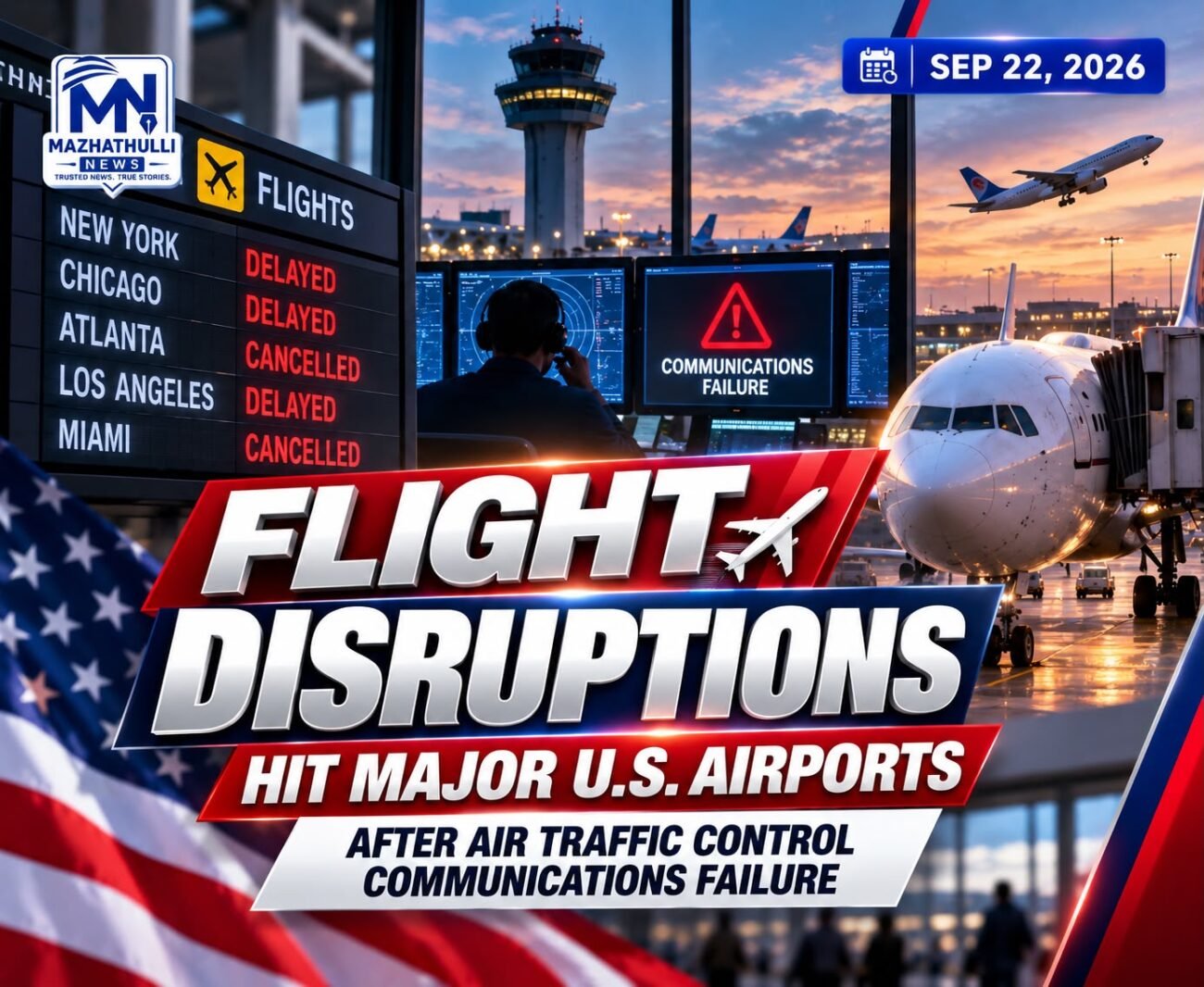
Flight Disruptions Hit Major U.S. Airports After Air Traffic Control Communications Failure
Flight operations were disrupted across several major airports in the northeastern United States on Monday after an equipment and communications failure affected an air traffic control facility responsible for managing aircraft in the region.
The Federal Aviation Administration (FAA) temporarily halted some flights at Philadelphia International Airport, Newark Liberty International Airport and Teterboro Airport after problems developed with radio frequencies at the Philadelphia Terminal Radar Approach Control facility, known as Philadelphia TRACON. The facility helps guide aircraft arriving at and departing from several major airports.
The disruption later spread across the region, with ground stops also affecting John F. Kennedy International Airport, LaGuardia Airport and Westchester County Airport. Boston Logan International Airport experienced additional delays as it took on diverted flights from other airports.
The FAA said the initial problem involved communications frequencies at Philadelphia TRACON. FAA Administrator Bryan Bedford said the facility lost its primary telecommunications circuit and that officials discovered a damaged fibre-optic backup line when they attempted to switch to the backup system. The fibre line was reportedly damaged during construction work.
The failure caused aircraft to be held on the ground and forced some flights to divert to other airports. Flight-tracking data showed hundreds of delays at Newark and Philadelphia, with some flights experiencing delays of more than two hours. Reuters reported that more than 600 flights at Newark and Philadelphia had been delayed, representing more than 20 per cent of flights at the two airports at that point.
Newark is a major hub for United Airlines, while Philadelphia is an important hub for American Airlines. Because of their roles as connecting hubs, disruptions at either airport can affect passengers travelling to destinations across the United States and internationally. Airlines were forced to adjust schedules as the FAA worked to restore normal air traffic operations. Passengers were advised to check directly with their airlines before travelling because flight schedules could change as the backlog moved through the system.
The disruption occurred at a particularly busy time for the New York region. World leaders and government delegations are arriving in New York for the United Nations General Assembly, adding pressure to an already busy transportation network. Nearly 200 countries and territories are expected to be represented during the General Assembly period.
The incident has also renewed attention on the reliability of America’s air traffic control infrastructure. The FAA manages more than 44,000 flights and approximately three million passengers each day, making the reliability of its communications, radar and navigation systems critical to the country’s aviation network.
The latest outage is not the first significant communications problem to affect the Philadelphia and Newark air traffic control systems. Newark experienced major communications outages in 2025, while a separate telecommunications outage previously affected communications and radar displays at Philadelphia TRACON.
The U.S. government has already allocated billions of dollars toward modernizing the nation’s air traffic control system. Congress approved $12.5 billion last year for infrastructure improvements and efforts to increase controller staffing following years of concerns about aging technology, congestion and operational disruptions.
The FAA has also been working on additional telecommunications connections and backup systems for Philadelphia TRACON. The agency has said the upgrades are intended to provide greater reliability and redundancy and reduce the possibility that a single telecommunications failure could significantly affect air traffic.
Monday’s disruption also coincided with the release of a Government Accountability Office report examining cybersecurity vulnerabilities in FAA communications systems. The report warned that some systems used to communicate with aircraft lack modern security protections and could be vulnerable to interference, spoofing or jamming. The GAO made nine recommendations, and the Department of Transportation said it agreed with them. Officials have not indicated that Monday’s communications failure was caused by a cyberattack. The immediate disruption has been attributed to equipment and telecommunications problems, including the damaged fibre connection.
The FAA has procedures designed to slow or stop aircraft movements when air traffic controllers cannot safely communicate with pilots. While such measures can cause significant delays, they are intended to maintain safe separation between aircraft when communications or other critical systems are unavailable.
As repairs and system checks continued, aviation authorities worked to clear the backlog of delayed and diverted flights. Because disruptions at major hubs can have a cascading effect across airline networks, passengers could continue to experience delays even after the affected air traffic control systems return to normal operation. The incident has once again highlighted the importance of reliable communications infrastructure for the U.S. aviation system and the challenges involved in modernizing technology that supports one of the world’s busiest air transportation networks.