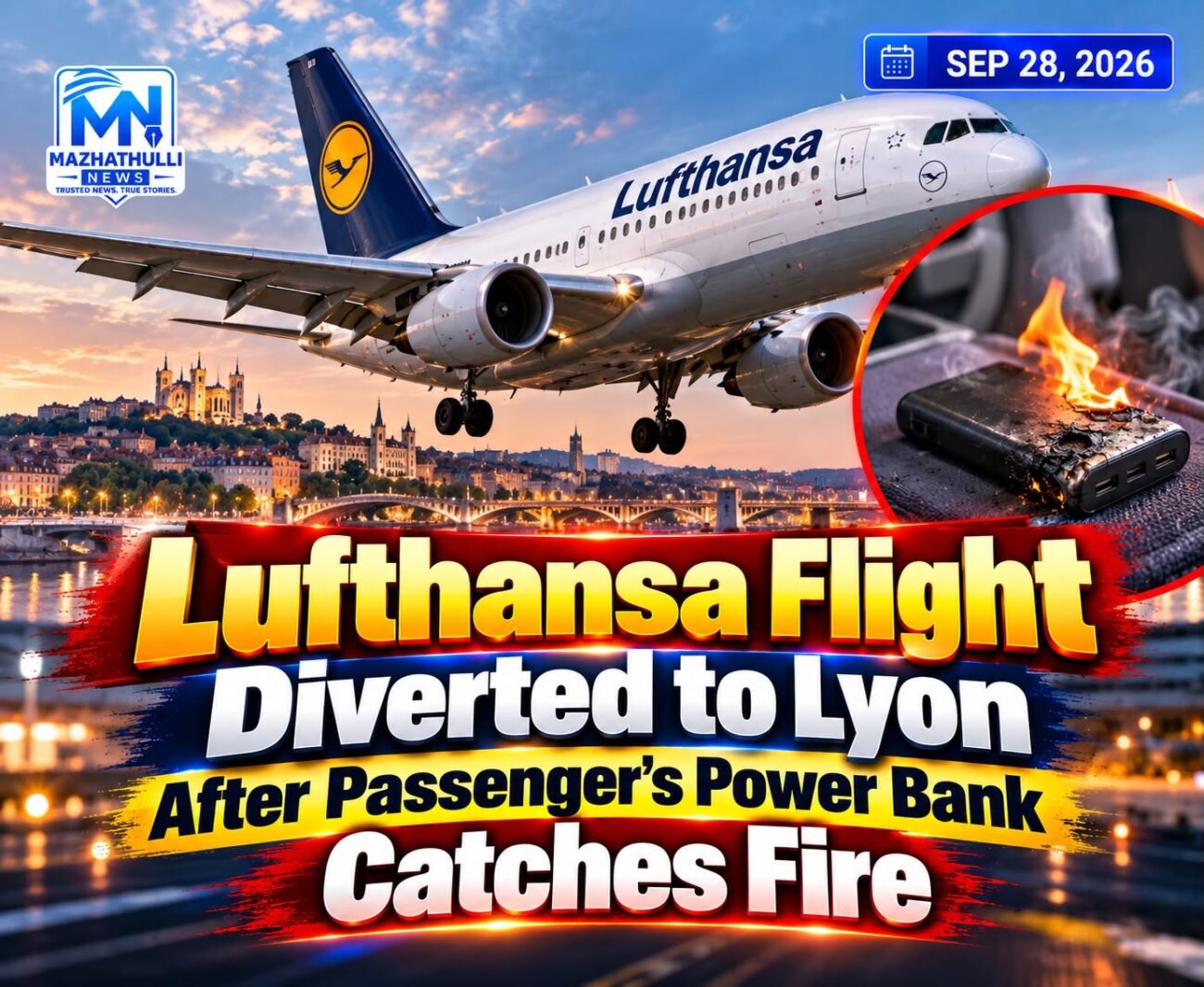
Lufthansa Flight Diverted to Lyon After Passenger’s Power Bank Catches Fire
A Lufthansa flight travelling from Frankfurt to Lisbon was diverted to Lyon, France, after a passenger’s power bank caught fire inside the aircraft cabin, prompting the crew to take emergency safety measures. The incident occurred on Saturday, Sept. 26, aboard Lufthansa flight LH1170, operated by an Airbus A321-200. The aircraft was carrying 198 passengers and six crew members when the battery incident occurred during the flight.
Cabin crew responded immediately after the power bank began overheating and caught fire. The battery was placed inside a special fire-containment bag designed to help isolate lithium-battery fires and prevent them from spreading. The crew managed to contain the incident, and no injuries were reported among passengers or crew members. However, because lithium-ion batteries can continue generating heat or reignite after appearing to be extinguished, the pilots decided to divert the aircraft as a precaution. The aircraft landed safely at Lyon Saint-Exupéry Airport in France. Emergency and airport personnel were available when the aircraft arrived, allowing the situation to be assessed and the passengers to leave the aircraft safely. The passengers were not able to continue their journey to Lisbon on the same aircraft. Lufthansa arranged accommodation for them overnight and rebooked them on alternative flights the following day. Power banks are classified as spare lithium-ion batteries and are subject to specific aviation safety rules because of the potential for overheating and fire. Unlike many other sources of fire, lithium-battery incidents can involve a rapid increase in temperature known as thermal runaway, which can produce smoke, flames and intense heat. The incident highlights why airlines generally require power banks and spare batteries to be carried in the passenger cabin rather than checked baggage. Having the batteries in the cabin allows crew members to identify smoke or overheating and respond quickly. Lufthansa has also introduced restrictions on the use of power banks during flights. The airline allows passengers to carry a limited number of power banks in the cabin, but they must comply with the airline’s requirements regarding storage and use. Passengers are generally advised not to place power banks in checked luggage and not to use batteries that are damaged, swollen, leaking or unusually hot. If a battery begins to smoke or heat up during a flight, passengers are instructed to immediately alert cabin crew rather than attempting to handle the device themselves. The aviation industry has been paying increased attention to lithium-battery incidents as the use of smartphones, laptops, tablets, cameras and portable chargers has grown among travellers.
Airlines around the world have introduced or strengthened rules governing spare batteries and power banks. Some carriers have prohibited passengers from using or charging power banks during flights, while others require them to remain easily accessible in the cabin. Although the Lufthansa incident caused a diversion, the aircraft was able to land safely and the immediate battery fire was contained without reported injuries. The diversion was a precautionary decision intended to reduce the risk associated with a potentially unstable lithium-battery fire. The incident also serves as a reminder for passengers to check airline-specific rules before travelling with power banks. Requirements can vary between airlines and may also depend on the battery’s capacity.
Lufthansa has not indicated that the aircraft suffered significant damage as a result of the incident. The airline arranged onward travel for the affected passengers while the aircraft remained in Lyon. The flight diversion adds to a growing number of aviation incidents involving lithium-ion batteries and underscores the importance of proper handling and storage of portable electronic devices during air travel.