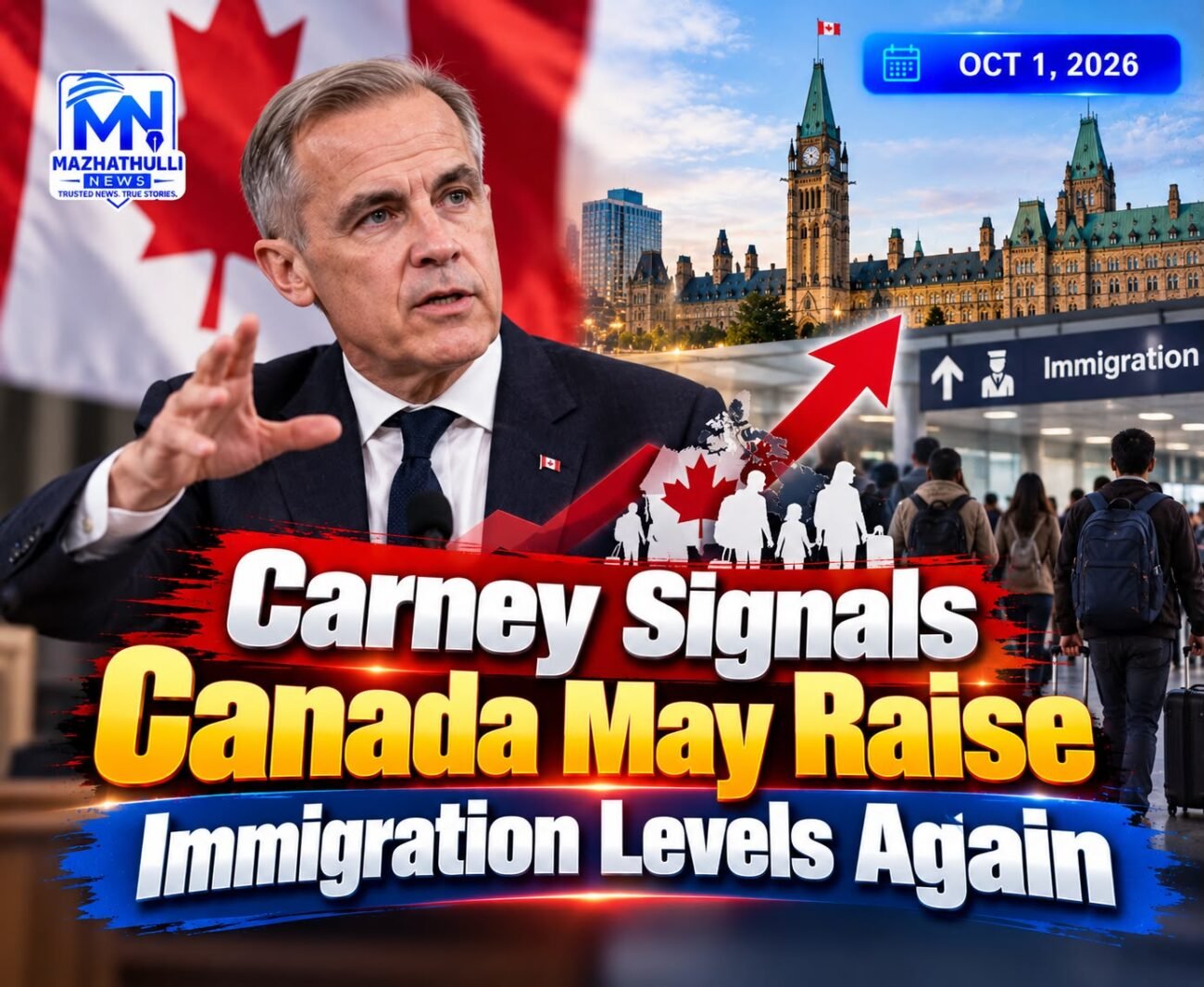
Carney Signals Canada May Raise Immigration Levels Again
Prime Minister Mark Carney has signalled that Canada could begin increasing immigration levels again after several years of measures aimed at slowing population growth and reducing the number of temporary residents in the country. In a recent interview with The New York Times, Carney said Canada’s immigration system is now “back under control” and suggested that the next question is when the country should resume a “controlled increase” in population.
“Now the question starts to become, when do we resume some controlled increase in the population, which is the nature of Canada?” Carney said. He added that the government wants to ensure the immigration system remains under control as population growth resumes.
Carney did not announce a new immigration target or provide a specific number of additional newcomers. His comments instead indicate that the government is considering a change in direction as it prepares the next Immigration Levels Plan, which will establish targets for 2027 through 2029. The federal government is expected to release that plan in the coming weeks. Under the current 2026–2028 plan, Canada has stabilized permanent-resident admissions at 380,000 per year while reducing the number of new temporary residents, including international students and temporary foreign workers. The current plan was introduced after a period of rapid population growth, during which Canada experienced a significant increase in temporary residents. The federal government said the earlier growth contributed to pressure on housing, health-care services, infrastructure and other public services. As part of its effort to rebalance the system, Ottawa has set a goal of reducing temporary residents to less than five per cent of Canada’s total population by the end of 2027.
Temporary-resident arrival targets under the current plan are 385,000 for 2026, followed by 370,000 in both 2027 and 2028. Permanent-resident admissions are targeted at 380,000 annually over the same period. The government has also introduced measures aimed at transitioning some temporary residents already established in Canada to permanent residence. One initiative is intended to accelerate permanent residence for about 33,000 skilled temporary workers over 2026 and 2027, particularly people working in sectors and communities where their skills are needed.
Another initiative is expected to provide permanent-residence pathways for approximately 115,000 protected persons over two years. Carney’s latest comments suggest that the government may view the reduction phase as approaching its intended objective. However, any increase would still have to be reflected in the formal immigration levels plan before it becomes government policy.
The potential shift comes as Canada’s population growth has slowed considerably. Recent population data show that the country experienced much slower year-over-year population growth than during the period of rapid expansion that followed the COVID-19 pandemic. The federal government is also trying to balance immigration with economic requirements. Ottawa has emphasized that future immigration policies will prioritize workers and skills that address labour-market needs, including areas such as health care, skilled trades and emerging technologies.
Economic immigration is expected to account for a larger share of permanent-resident admissions under the current plan. The government has said the objective is to attract workers and talent needed to support economic growth while also ensuring that immigration levels remain sustainable. Carney has previously argued that population growth is important to Canada’s economic outlook. With population growth slowing, the government is now facing the challenge of determining how immigration can support economic expansion while managing pressures on housing and public services. The possible increase is likely to generate debate among political parties, businesses, economists, immigrant-serving organizations and communities across the country. Supporters of higher immigration levels have pointed to labour shortages, demographic aging and the need for skilled workers, while critics have raised concerns about housing affordability, infrastructure capacity and access to public services. The government has not yet indicated whether any future increase would primarily involve permanent residents, temporary workers, international students or a combination of categories. The distinction will be important because Canada has been reducing temporary-resident arrivals while maintaining relatively stable permanent-resident admissions. A change in one category would not necessarily mean an increase across the entire immigration system. For prospective immigrants, the upcoming 2027–2029 Immigration Levels Plan will therefore be closely watched. Changes to permanent-resident targets could affect the number of invitations and admissions available through economic immigration programs, while changes to temporary-resident targets could affect international students and temporary foreign workers. For now, there is no new immigration target to replace the existing plan. Carney’s comments signal that Ottawa is considering a controlled increase, but the exact scale, timing and categories involved will only become clear when the government announces its next immigration levels plan.