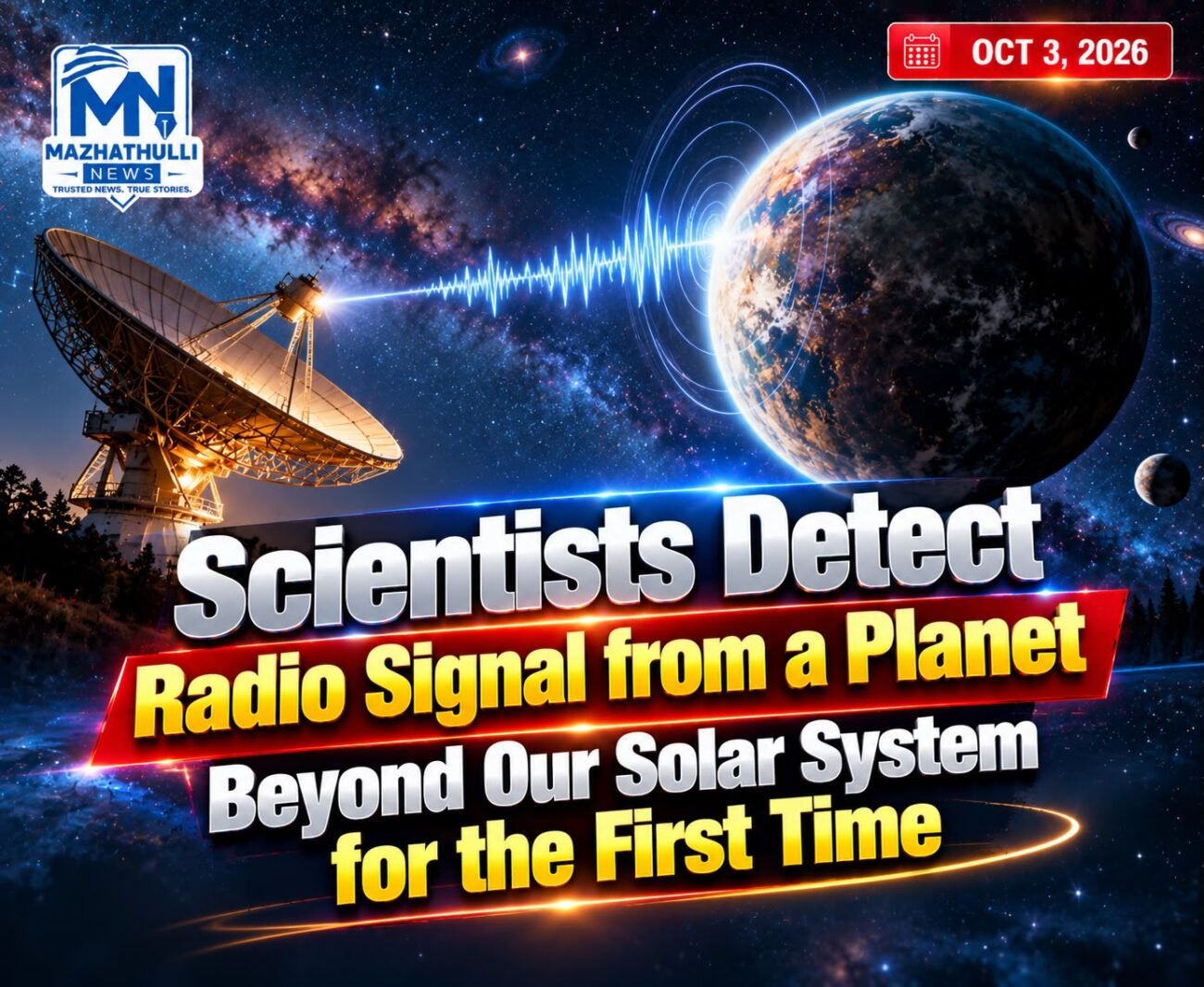
Scientists Detect Radio Signal from a Planet Beyond Our Solar System for the First Time
Astronomers have reported a potentially important breakthrough in the study of planets beyond our solar system after detecting a radio signal believed to have originated from a distant exoplanet. The observation could open a new way of investigating the hidden characteristics of planets orbiting other stars, particularly their magnetic fields and interactions with the space environment surrounding them. If confirmed through further research, the finding could help scientists understand how distant planetary systems work and identify important differences between planets beyond our solar system and those closer to home. Radio signals from planets are particularly valuable because they can reveal information that is difficult to obtain through ordinary optical observations. Unlike visible light, radio waves can carry clues about the interaction between a planet’s magnetic field and charged particles released by its host star. By analysing the strength, frequency and patterns of these emissions, researchers may be able to learn more about a planet’s magnetic environment and the activity taking place around it. Magnetic fields are considered an important feature of planetary environments. On Earth, the magnetic field helps deflect many charged particles arriving from the Sun, contributing to the protection of our atmosphere and creating phenomena such as the northern and southern lights. Other planets in our solar system also produce radio emissions through interactions involving their magnetic fields. Jupiter, for example, generates powerful radio signals because of its strong magnetic environment and its interaction with charged particles. Scientists are interested in finding out whether similar processes occur on planets orbiting distant stars. When charged particles from a star interact with a planet’s magnetic field, they can generate radio waves. The characteristics of those emissions may offer clues about the strength and structure of the magnetic field, as well as the conditions surrounding the planet. Studying these signals could eventually allow astronomers to investigate planetary properties that are difficult to measure using other techniques. Detecting such emissions is extremely challenging. Exoplanets are located many light-years away, and the radio signals they produce can be very faint by the time they reach Earth. In addition, radio emissions from their host stars and other sources in space can make it difficult to distinguish a planetary signal from background interference. Researchers therefore need highly sensitive radio telescopes, careful analysis and repeated observations to establish where a signal originates. The development of more advanced radio astronomy instruments is helping scientists investigate these distant worlds in greater detail. By observing radio waves across different frequencies and comparing signals over time, astronomers can look for patterns that may indicate an interaction between a planet and its host star. Further observations are essential to determine whether the reported signal is genuinely associated with the planet and to understand the physical process responsible for producing it. The potential discovery is also relevant to the search for habitable planets. A magnetic field may help a planet retain its atmosphere by reducing the impact of charged particles from its star. However, having a magnetic field does not automatically mean that a planet can support life. Temperature, atmospheric composition, the presence of liquid water, radiation levels and many other conditions must also be considered. Scientists would need much more information before drawing conclusions about the possibility of life on any distant world.
Astronomers have already discovered thousands of exoplanets using techniques such as the transit method, which detects a small reduction in a star’s brightness when a planet passes in front of it, and the radial velocity method, which measures the slight movement of a star caused by the gravitational pull of an orbiting planet. These methods have transformed our understanding of planetary systems, but studying magnetic fields has remained a major challenge. Radio astronomy could add another important tool to this research. In the future, scientists may be able to use planetary radio emissions to compare magnetic environments across different star systems, investigate how stellar activity affects planets and better understand why some worlds retain their atmospheres while others may lose them. The reported detection therefore represents an exciting research possibility, although additional observations and independent confirmation will be important. Scientists will need to establish the signal’s precise origin and rule out other possible sources before its significance can be fully understood. If the finding is confirmed, it could mark a major development in the study of exoplanets and give astronomers a new way to explore the invisible magnetic environments of worlds far beyond our solar system.