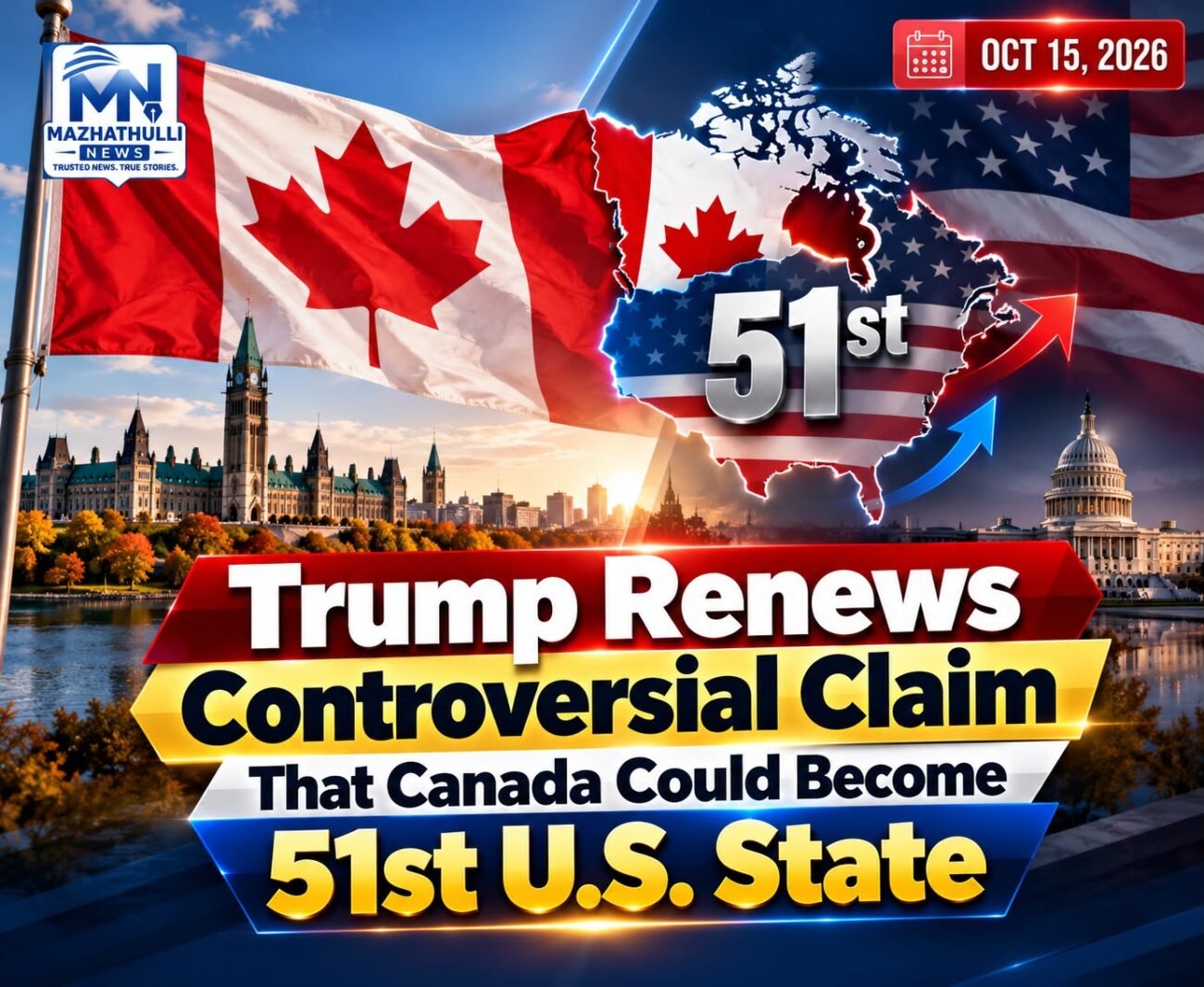
Trump Renews Controversial Claim That Canada Could Become 51st U.S. State
U.S. President Donald Trump has renewed his controversial claim that Canada will eventually become the 51st state of the United States, linking the possibility to ongoing trade disputes, Canadian tariffs and the movement of automobile manufacturing into the United States. Speaking at a campaign rally in Bullhead City, Arizona, on October 14, Trump criticized Canada’s trade policies and argued that the United States was being treated unfairly by its northern neighbour. He told supporters that Canada would ultimately become part of the United States, repeating a statement he has made several times since returning to the White House. “They’ll end up being the 51st state, because it’s the only way it works,” Trump said. He added that the United States did not need Canada in the same way Canada needed the American market, reinforcing his argument that the two countries’ economic relationship favours Canada. Trump focused particularly on Canada’s dairy tariffs, claiming that American producers face extremely high duties when attempting to sell certain products in the Canadian market. He cited a tariff rate of 409 per cent on some dairy imports beyond specified quantities. Canada’s supply-management system restricts production and regulates imports in sectors including dairy, poultry and eggs, with the aim of maintaining domestic market stability and supporting Canadian producers. The president also claimed that automobile companies were moving production to the United States to avoid tariffs. He argued that American trade measures were encouraging manufacturers to establish or expand operations within the country rather than continue relying on cross-border production. Trump questioned why the United States should provide economic support to Canada while, in his view, receiving insufficient benefits in return. During the rally, he referred to annual amounts ranging from $80 billion to $100 billion, although he did not provide a detailed breakdown explaining those figures. His comments reflected his broader criticism of the economic relationship between the two countries. The president also compared Canada with Greenland, which he has repeatedly expressed an interest in bringing under American control. By invoking Greenland, Trump suggested that Canada’s future relationship with the United States could change significantly, but he did not present a formal proposal, a timetable or a specific plan for annexation. Trump’s latest remarks have renewed attention on relations between Washington and Ottawa, which have been strained by disagreements over tariffs, manufacturing and market access. His repeated references to Canada becoming an American state have drawn concern because of the implications for Canadian sovereignty and political independence. Canada is an independent country with its own constitution, government, parliament and international relationships. Becoming a U.S. state would require extraordinary political and constitutional changes, and there is no agreement between the two countries to pursue such a move. Canadian political leaders have consistently defended the country’s independence. Prime Minister Mark Carney has emphasized the importance of protecting Canada’s national interests while maintaining a productive relationship with the United States. The two countries continue to cooperate on trade, energy, security and defence, despite significant disagreements over economic policy. The United States and Canada maintain one of the world’s most closely integrated economic relationships. Their industries are connected through extensive supply chains in automotive manufacturing, agriculture, energy, steel, transportation and consumer goods. Goods and services worth billions of dollars cross their shared border, supporting businesses and employment in both countries. Changes to tariffs can increase production costs, disrupt supply chains and affect prices for businesses and consumers. Canadian companies that depend on access to the American market may face additional expenses, while U.S. manufacturers that rely on Canadian materials and components can also be affected by trade restrictions. The automotive sector is particularly sensitive because vehicles and components frequently cross the border during manufacturing. A car assembled in one country may contain parts produced in several locations across North America. Increased tariffs can therefore affect manufacturers on both sides of the border, potentially influencing investment decisions, vehicle prices and employment.
Canada’s dairy supply-management system remains another point of disagreement. Canadian governments have defended the system as a way to provide stability for domestic farmers, while American officials have argued that some restrictions limit access to the Canadian market. Trump’s comments come as the two governments continue to face pressure to address their trade differences. Negotiations over tariffs and market access remain important for businesses seeking certainty about future investment and cross-border operations. Although Trump has again suggested that Canada could eventually become the 51st U.S. state, his remarks at the Arizona rally did not amount to a formal policy announcement. They also did not change Canada’s legal or constitutional status as an independent nation. For Ottawa, the immediate challenge is to protect Canadian economic interests, defend national sovereignty and manage relations with its largest trading partner. For businesses, the uncertainty surrounding tariffs and trade negotiations remains a major concern. Trump’s latest statement is likely to reignite debate across Canada about economic dependence on the United States, the future of cross-border trade and the country’s ability to protect its interests amid growing political pressure from Washington. Despite the president’s repeated rhetoric, Canada remains a sovereign country, and any fundamental change to its status would involve far-reaching political and constitutional questions.