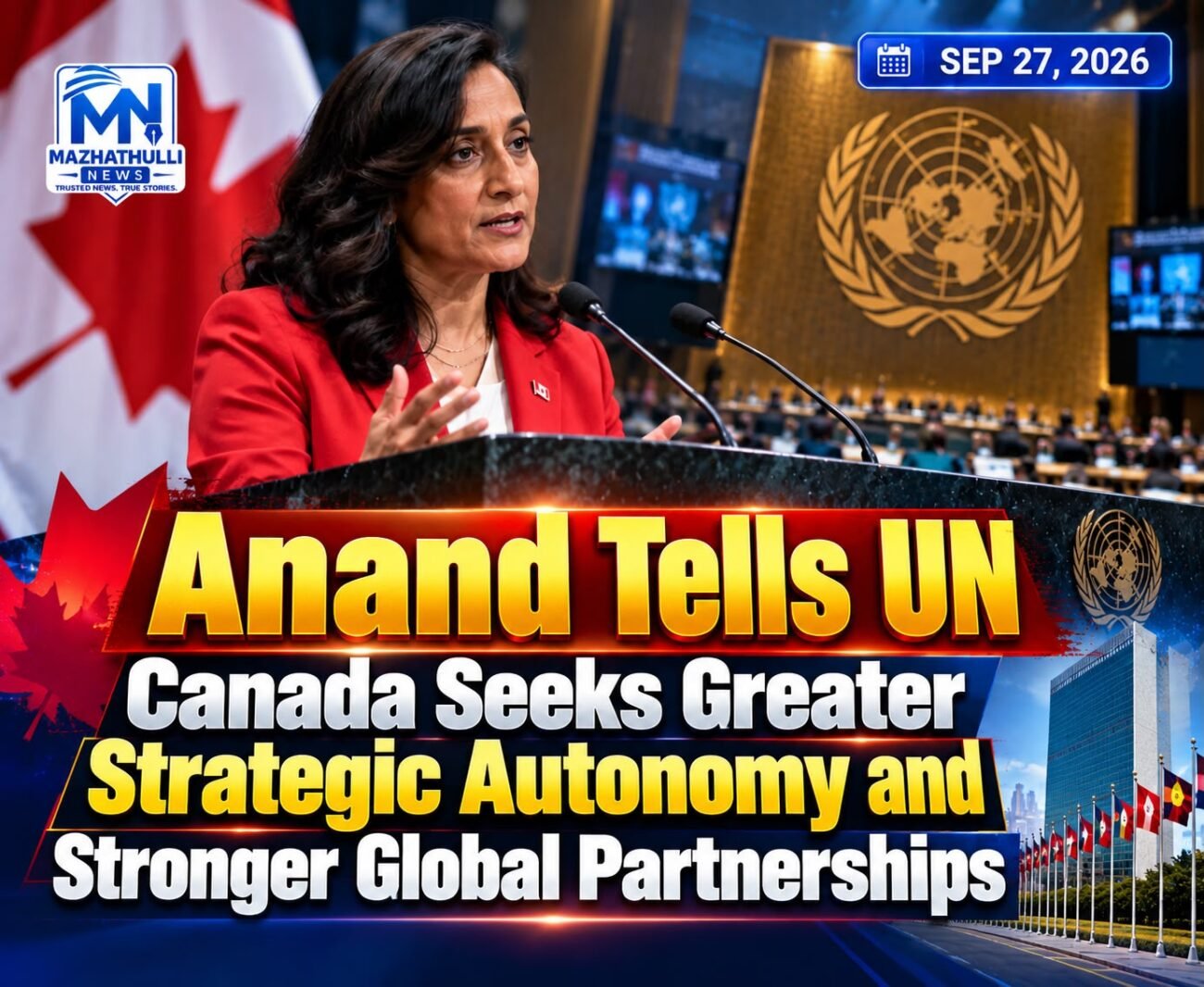
Anand Tells UN Canada Seeks Greater Strategic Autonomy and Stronger Global Partnerships
Foreign Affairs Minister Anita Anand has told the United Nations that Canada is seeking greater “strategic autonomy” as the international order faces growing geopolitical and economic pressures. Speaking Saturday during Canada’s annual address to the United Nations General Assembly in New York, Anand said major powers are increasingly stepping away from global economic co-operation and that Canada needs to strengthen its ability to act independently while working closely with other middle powers.
“In the face of this rupture, Canada’s goal is to achieve greater strategic autonomy,” Anand said. She said Canada wants to build greater capacity in areas considered strategically important, including emerging technologies, critical minerals, defence production and energy. The government has also been working to diversify Canada’s trade relationships beyond North America. Anand’s speech reflects Prime Minister Mark Carney’s broader foreign-policy approach, which emphasizes cooperation among middle powers and stronger partnerships with countries that share common interests. Canada has increasingly highlighted the need to reduce vulnerabilities created by dependence on individual countries or supply chains. The foreign affairs minister also emphasized the importance of national sovereignty and international rules. She said Canada will continue working with other countries to strengthen stability, common rules and respect for sovereignty at a time of significant changes in the global order.
Anand described Canada as an open and pluralistic society where disagreements can be addressed through democratic institutions and public debate. She said civil debate and respect for differences are important parts of Canada’s democratic system. “Canada is an open, pluralistic society, with a public square full of robust and civil debate,” Anand told delegates.
She also addressed several major international conflicts and humanitarian issues. Canada continues to call for a just peace in Ukraine and support for the self-determination of both Palestinians and Israelis. Anand also condemned hate-based violence and antisemitism, referring to a recent shooting at a synagogue in Belleville, Ontario. On defence and security, Anand reaffirmed Canada’s commitment to NATO and the transatlantic alliance. She also highlighted Canada’s efforts to strengthen security in the Arctic, saying the work is being carried out in partnership with Indigenous Peoples. Canada’s approach to the Arctic has become an increasingly important part of its national-security policy as geopolitical competition in the region grows. Ottawa has been investing in defence capabilities, infrastructure and partnerships aimed at strengthening Canada’s ability to monitor and protect its northern territory.
Anand also expressed Canada’s continued support for the International Criminal Court, amid efforts by the United States to challenge the institution. She reiterated Canada’s support for international institutions and multilateral cooperation. Canada is also seeking a seat on the United Nations Human Rights Council, with an election expected next year. Anand said Canada intends to continue advocating for human rights, democracy and international co-operation. The minister’s speech included references to a range of international issues, including the situation in Iran, the return of Ukrainian children taken by Russia, the crisis in Haiti, the war in Sudan, gender equality, LGBTQ+ rights and artificial intelligence. Anand also said Canada is prepared to work with whichever candidate UN members eventually select as the organization’s next secretary-general. For the second consecutive year, Anand delivered Canada’s national address instead of Prime Minister Mark Carney. Carney attended the UN General Assembly earlier in the week but did not deliver Canada’s formal national statement because of scheduling considerations. The speech comes as Ottawa seeks to strengthen relationships with European countries and other middle powers while maintaining its existing alliances. The federal government has increasingly described strategic autonomy as the ability to strengthen Canada’s own economic, defence and energy capacity while continuing to work with trusted international partners. Anand’s UN address therefore placed strategic autonomy, multilateral cooperation, sovereignty and democratic institutions at the centre of Canada’s foreign-policy message as the country navigates an increasingly uncertain global environment.