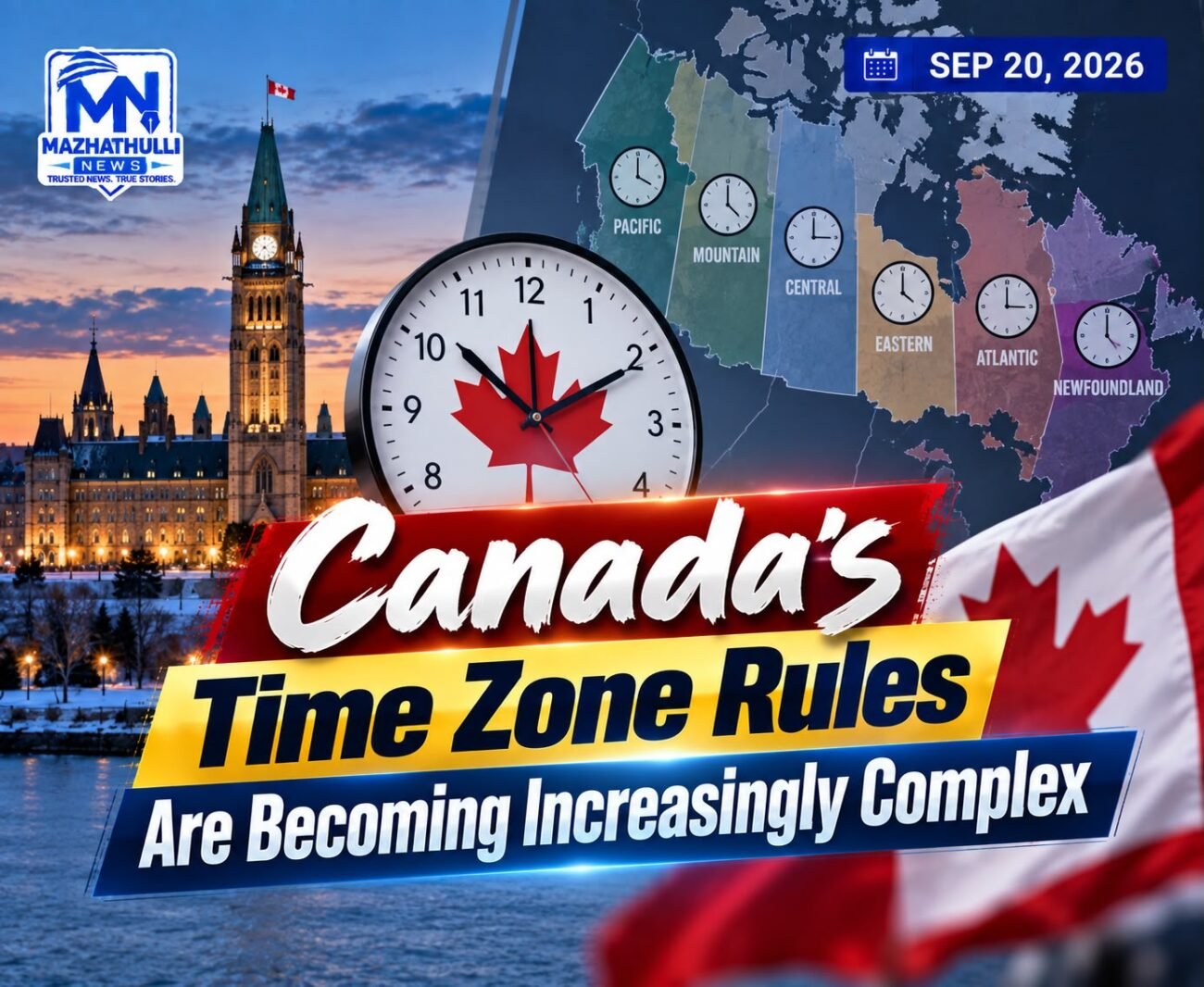
Canada’s Time Zone Rules Are Becoming Increasingly Complex
Canada’s timekeeping system is becoming increasingly complicated as provinces and territories adopt different approaches to daylight saving time, creating a growing patchwork of clock rules across the country.
Canada spans six main time zones — Pacific, Mountain, Central, Eastern, Atlantic and Newfoundland — but there is no single nationwide rule governing daylight saving time. Provinces and territories have the authority to determine how and when their clocks change, resulting in a number of exceptions and regional differences.
The issue has gained renewed attention as several jurisdictions have moved toward keeping the same time throughout the year. Yukon adopted permanent standard time in 2020, while most of Saskatchewan has not observed seasonal clock changes for decades.
British Columbia has also moved toward a permanent daylight-time arrangement for most of the province, meaning residents will no longer make the traditional fall clock change. The change creates new differences with neighbouring jurisdictions that continue to switch between standard and daylight time.
Alberta has likewise been examining its approach to daylight saving time. The province has held public discussions and debates over whether Albertans should continue changing their clocks twice a year, although the current system remains in place.
The situation is particularly noticeable along provincial borders. Communities located only a short distance apart can sometimes have different local times, depending on which side of the border they are on and whether the jurisdictions observe daylight saving time.
Saskatchewan provides one of the country’s most unusual examples. Most of the province stays on Central Standard Time throughout the year, while Lloydminster, which sits directly on the Alberta-Saskatchewan border, follows Alberta’s clock rules. This means the community can effectively operate on a different time from much of Saskatchewan.
Ontario also has areas where time-zone boundaries can be confusing. Northwestern communities such as Kenora follow Central Time, while most of Ontario operates on Eastern Time. Travellers crossing the province can therefore encounter a one-hour difference without leaving Ontario.
Newfoundland and Labrador adds another layer of complexity because Newfoundland uses a half-hour time zone. Newfoundland Standard Time is 30 minutes behind Atlantic Standard Time, making it one of the few regions in North America where the clock differs from neighbouring time zones by half an hour rather than a full hour.
Nunavut presents another unusual situation because the territory stretches across three time zones. Different communities within the territory can therefore have different local times even though they are part of the same territorial government.
The differences have practical consequences for Canadians who travel or work across provincial and territorial boundaries. Businesses with employees in multiple jurisdictions must carefully account for local time when scheduling meetings, shifts, deliveries and appointments.
The impact is also felt in broadcasting and telecommunications. A television program, sporting event or online event scheduled for a particular time in one province may appear at a different local time elsewhere. Companies increasingly rely on automated time-zone systems to prevent scheduling errors.
Transportation companies face similar challenges. Airline, rail and bus schedules must account for changes in local time, particularly on routes crossing multiple time zones. Travellers can also encounter confusion when booking connections or arranging airport pickups.
The differences become even more noticeable during the weeks when some jurisdictions change their clocks while others do not. During those periods, communities that are normally in the same time relationship can temporarily find themselves an hour apart.
Canada’s official time is maintained by the National Research Council, which publishes information on the country’s time zones and daylight-saving rules. However, the actual legal rules governing clock changes are generally established by provincial and territorial authorities.
Under the traditional system, jurisdictions observing daylight saving time move their clocks forward by one hour in the spring and back by one hour in the fall. The standard schedule calls for the spring change on the second Sunday in March and the return to standard time on the first Sunday in November.
But the increasing number of exceptions means Canadians can no longer assume that every province or territory will make the same change on the same day.
For people living near provincial borders, the differences can be especially important. A short drive across a border can sometimes mean changing the clock, while residents of other border communities may remain on the same time throughout the year because of special local arrangements.
Supporters of permanent time systems have cited potential benefits such as eliminating the disruption associated with changing clocks twice a year. Critics of the changes have raised concerns about darker mornings or evenings, depending on which permanent time is selected.
The debate is therefore not simply about what time Canadians should have on their clocks. It also involves questions about transportation, commerce, schools, workplaces, public services and coordination between neighbouring jurisdictions.
With more provinces and territories considering changes to their timekeeping policies, Canada’s time-zone map is likely to remain a moving target. For Canadians travelling, doing business or communicating across the country, checking the local time may become increasingly important rather than relying on assumptions based on provincial borders.
The result is a uniquely Canadian situation: a country already separated by several hours from coast to coast is now developing even more variations in how those clocks operate throughout the year.