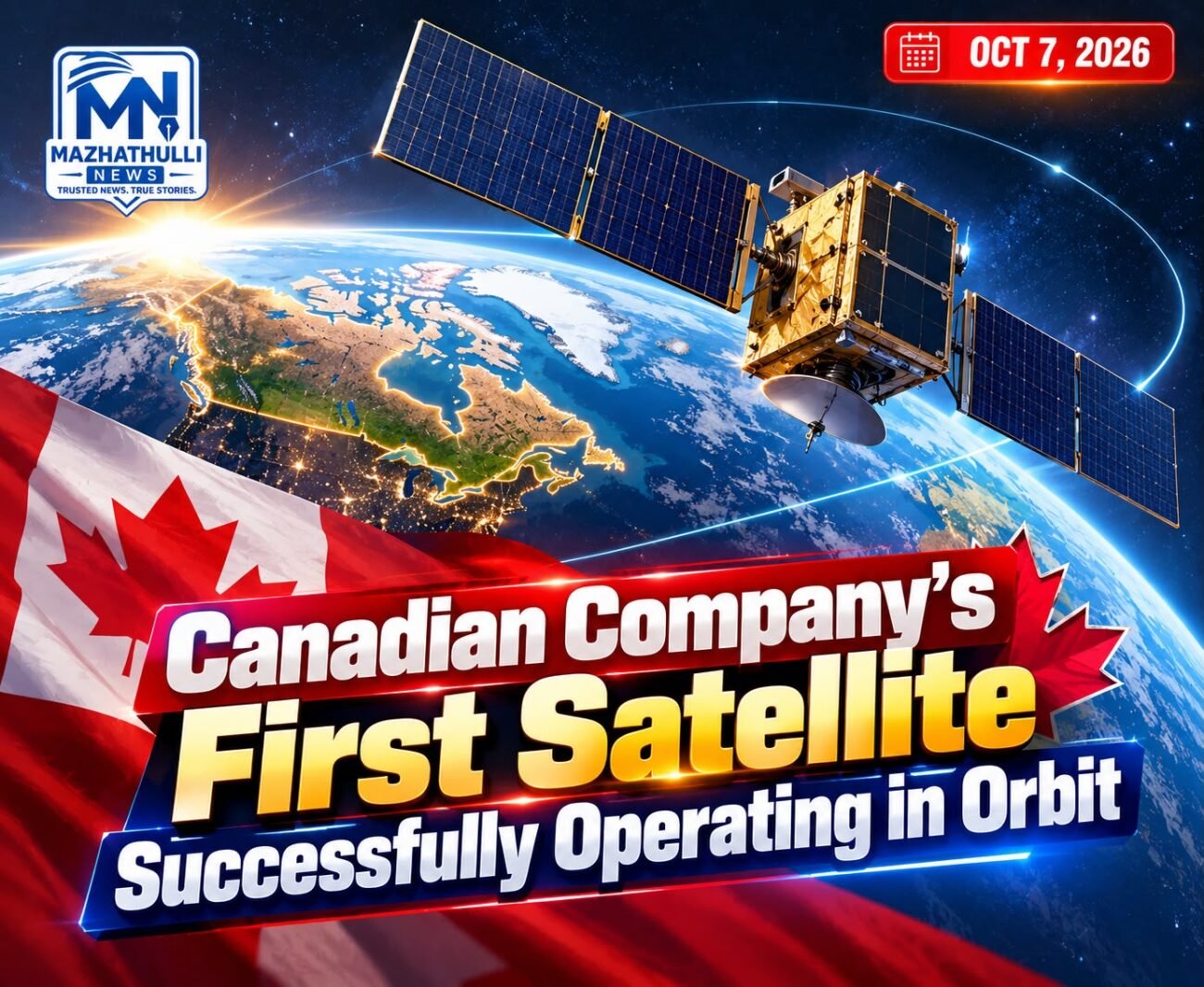
Canadian Company’s First Satellite Successfully Operating in Orbit
A Canadian aerospace company has reached a major milestone after its first satellite successfully entered orbit and began operating normally just days after launch. Markham, Ontario-based NordSpace announced that its Terra Nova pathfinder satellite has successfully completed its Launch and Early Orbit Phase and is now preparing to enter its commissioning phase. The company says the satellite is in very good health, with all mission objectives achieved so far. Terra Nova was launched aboard SpaceX’s Transporter-18 rideshare mission from Vandenberg Space Force Base in California. The mission carried multiple payloads into orbit, including Canadian satellites, marking another significant launch for Canada’s growing commercial space sector.
The successful operation of Terra Nova makes NordSpace the first Canadian launch company to have its own hardware operating in space. The achievement is particularly important because the company is developing an end-to-end space program that includes spacecraft, rockets, mission-control systems and launch infrastructure. The satellite was designed, built, integrated and tested at NordSpace’s Space Systems Lab in Markham. The company says the entire program progressed from initial design to launch readiness in about nine months, with thermal, vacuum and vibration testing carried out in-house. Terra Nova is a privately funded, dual-use demonstration mission designed to test technologies that could eventually be used for both commercial and defence-related applications. The satellite carries several systems developed by NordSpace that are expected to play a role in the company’s future spacecraft and launch programs. Among the technologies aboard Terra Nova is Athena, NordSpace’s scalable spacecraft platform, along with Zephyr-EP, an electric propulsion system designed to provide propulsion capabilities in orbit. The satellite also carries Chronos, an artificial-intelligence-enabled camera system capable of processing information onboard the spacecraft. The technology is intended to demonstrate how satellite data can be analyzed in space before being transmitted to ground stations. Another important system is Sentinel, NordSpace’s mission-control platform. The company says Sentinel will eventually support its future missions, including planned launches of its orbital rockets. Terra Nova is expected to be used for demonstrations involving space-domain awareness, wildfire monitoring and Arctic observation. These capabilities could have applications in monitoring large areas of Canada and identifying potential threats or environmental changes more quickly. The wildfire-monitoring component is particularly significant for Canada, where satellite imagery is increasingly used to track fires, smoke and changing environmental conditions. By using artificial intelligence onboard the satellite, NordSpace aims to demonstrate faster processing of information and potentially quicker delivery of useful data to people on the ground. The Arctic is another major area of interest. Satellite technology can provide persistent observation of remote regions that are difficult and expensive to monitor from the ground. Improved space-based monitoring could support environmental observation, emergency response and awareness of activity across Canada’s northern territory. For NordSpace, however, Terra Nova is about more than demonstrating a single satellite. The company is using the mission to gain practical experience operating hardware in orbit and to reduce technical and operational risks ahead of its planned rocket launches. The company is developing the Tundra and Tempest orbital launch vehicles and is also working on the Atlantic Spaceport Complex in Newfoundland and Labrador. NordSpace aims to eventually provide launch services from Canadian soil.
Operating Terra Nova allows the company to experience the process from the perspective of a satellite operator and future launch customer. The information gathered from the mission is expected to influence the design, testing and operation of future spacecraft and launch systems. The successful mission also gives NordSpace what is known as flight heritage — real-world evidence that its hardware and software have operated successfully in space. This can be important when developing future commercial and government missions because proven systems can reduce technical uncertainty. The company says its mission team remains in continuous communication with Terra Nova from the ground. Over the coming weeks, engineers will continue commissioning the spacecraft, activating and testing its systems and evaluating the performance of its sensors and other equipment. NordSpace is also planning additional spacecraft missions and future launch programs. The company hopes that the experience gained from Terra Nova will help establish a larger Canadian space ecosystem capable of designing, manufacturing, launching and operating spacecraft domestically. The milestone comes as Canada’s commercial space industry continues to expand, with companies developing satellite systems, Earth-observation technology, launch vehicles and other space infrastructure. For NordSpace, Terra Nova represents a first step toward its broader goal of building a Canadian end-to-end space missions company. With its first satellite now operating successfully in orbit, the company has moved from testing its technology on Earth to gaining real operational experience in space.