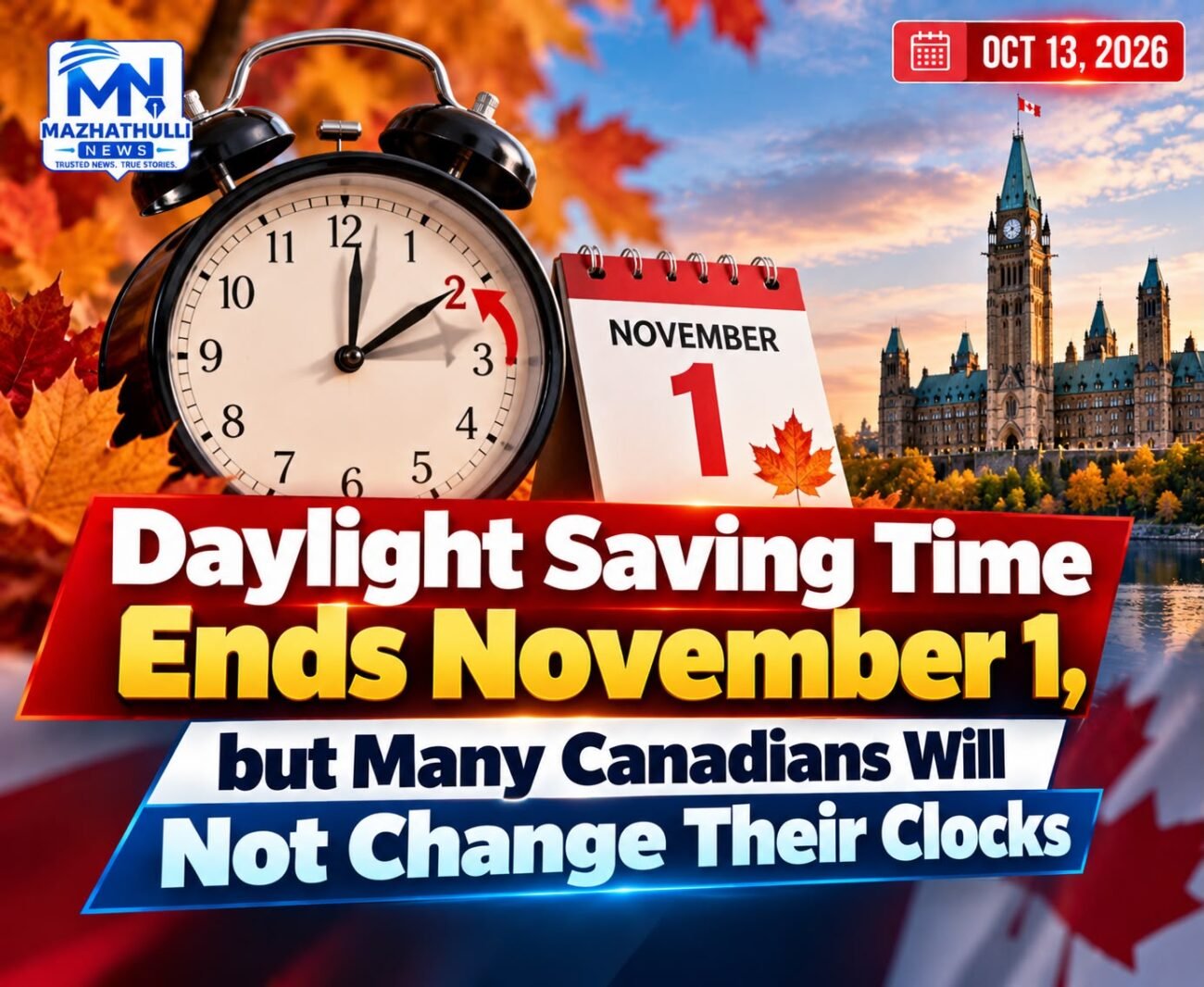
Daylight Saving Time Ends November 1, but Many Canadians Will Not Change Their Clocks
Daylight saving time will end in parts of Canada on Sunday, November 1, 2026, but a series of recent changes means millions of Canadians will no longer need to turn their clocks back this fall. In regions that continue to observe seasonal time changes, clocks will move back one hour at 2 a.m., returning to 1 a.m. The change will give residents an extra hour overnight and mark the transition to standard time for the winter months. However, British Columbia, Alberta, Manitoba and the Northwest Territories have adopted permanent time arrangements and will not turn their clocks back on November 1. Saskatchewan and Yukon also do not observe the usual seasonal clock change across most or all of their jurisdictions.
The changes mean that the traditional November time adjustment will apply mainly to Ontario, Quebec, the Atlantic provinces and most of Nunavut. Some local exceptions remain, particularly in regions that follow different time-zone arrangements. In Alberta, the province has adopted permanent Alberta Time, equivalent to UTC−6. Residents will therefore keep their clocks unchanged on November 1 instead of returning to Mountain Standard Time. The provincial government says the new arrangement is intended to provide greater consistency for families, businesses, schools and public services. British Columbia also made its final seasonal clock change in March 2026. The province will remain on permanent Pacific Time, set at UTC−7 for most of the province. Some communities in southeastern British Columbia continue to follow Mountain Time arrangements, so local rules may differ. Manitoba has also decided to remain on daylight time throughout the year. The decision followed public consultation in which a large majority of respondents supported ending the twice-yearly clock changes. The Northwest Territories has introduced a permanent time standard equivalent to UTC−6, aligning it with Alberta and parts of neighbouring regions.
Saskatchewan has long remained on Central Standard Time throughout the year across most of the province. Yukon also follows a permanent time standard, meaning residents in these jurisdictions will not need to adjust their clocks on November 1. In contrast, most of Ontario and Quebec will still move back one hour. New Brunswick, Nova Scotia, Prince Edward Island, and Newfoundland and Labrador will also follow the traditional seasonal change. Most of Nunavut is expected to change clocks, although local arrangements vary. The new system will also alter time differences between Canadian cities. From November 1, Calgary will be one hour behind Toronto, while Vancouver will be two hours behind Toronto. Winnipeg and Toronto will share the same time during the winter under Manitoba’s new arrangement. The changes could create scheduling challenges for businesses, airlines, healthcare providers and organizations operating across provincial boundaries. Companies that coordinate shifts, appointments and virtual meetings in different time zones may need to review their calendars and computer systems to ensure that scheduled times remain accurate. Most smartphones, computers and internet-connected devices should update automatically, provided their software and time-zone settings are current. However, older devices, manual clocks and certain workplace systems may require adjustments or software updates. Daylight saving time has long been debated in Canada. Supporters of ending seasonal changes argue that maintaining a consistent time throughout the year reduces disruptions to sleep, family routines and business operations. Others have raised concerns about darker winter mornings under permanent daylight time. With more provinces and territories changing their approach, Canadians are being encouraged to check local time rules rather than assume the entire country will turn clocks back on the same date. The November 1 transition will mark a significant change in how time is observed across the country, even though many residents will leave their clocks exactly as they are.