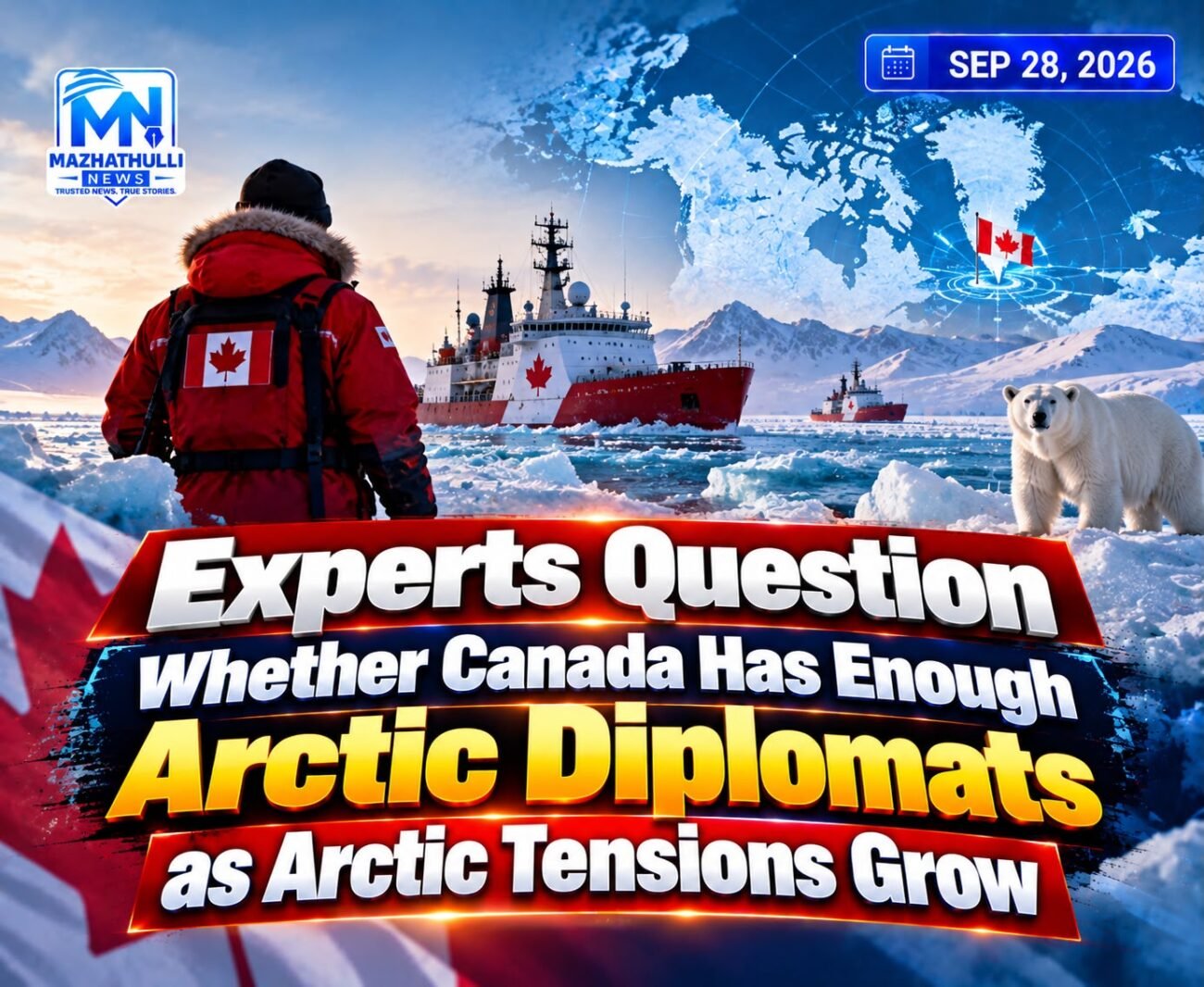
Experts Question Whether Canada Has Enough Arctic Diplomats as Arctic Tensions Grow
As Canada prepares for a major expansion of defence, infrastructure and economic activity in the Arctic, regional experts are questioning whether the country has enough diplomats and specialists on the ground to support its growing ambitions in the North. The concerns come as the Arctic becomes increasingly important to Canada’s national security, economic interests and international relationships. Climate change is opening new areas of the region, while competition involving Russia, the United States, China and other Arctic and non-Arctic countries is increasing. Natan Obed, president of Inuit Tapiriit Kanatami, said Canada does not have a sufficiently deep pool of expertise within Global Affairs Canada when it comes to Arctic diplomacy. He argued that the country needs stronger diplomatic capacity to understand the region and build long-term relationships with Arctic partners. One of the concerns involves Canada’s decision in 2023 to close the Canadian International Arctic Centre, which had operated from Canada’s embassy in Norway since 2009. The centre had served as a hub for Arctic diplomacy and helped Canadian officials develop contacts throughout the circumpolar region. Global Affairs Canada cited the high cost of maintaining the operation in Oslo and estimated annual savings of about $550,000 from its closure. Artur Wilczynski, a former Canadian ambassador to Norway, has criticized the decision, arguing that effective Arctic diplomacy requires people with deep regional knowledge and established relationships. He said those relationships cannot simply be replaced through virtual meetings. Canada subsequently increased its focus on Arctic diplomacy. In December 2024, Ottawa released its Arctic Foreign Policy, which identified growing geopolitical competition and security challenges in the region and called for stronger cooperation with Arctic allies and partners. The policy committed Canada to appointing an Arctic ambassador, opening new consulates in Greenland and Alaska, strengthening cooperation with Indigenous and northern communities, and increasing Canada’s diplomatic engagement throughout the circumpolar region. Virginia Mearns currently serves as Canada’s Arctic Ambassador and Senior Arctic Official to the Arctic Council. Her office has a presence in Iqaluit as well as Ottawa, with a mandate that includes working with Indigenous Peoples, territorial and provincial governments and other northern communities. Canada also opened its first consulate in Greenland’s capital, Nuuk, earlier this year. However, documents obtained by The Canadian Press indicate that the mission has only one staff member, despite an original plan for three full-time positions. The five-year operating cost of the Nuuk consulate was estimated at about $8.76 million, including staffing and other services. Global Affairs Canada said the figures were prepared for planning purposes and that staffing levels could affect actual costs. An internal Global Affairs audit completed in 2025 also identified consequences from the closure of the Canadian International Arctic Centre. The audit found that the decision resulted in the loss of important Arctic contacts and reduced expertise, outreach and support available to some Canadian missions. The issue is particularly significant because Canada wants northern and Indigenous voices to play a greater role in its international Arctic diplomacy. The Global Arctic Leadership Initiative helps connect Inuit and other northern representatives with international projects, conferences and Arctic networks. Experts say maintaining those relationships is important because people who live in the North can provide knowledge and perspectives that cannot easily be developed from Ottawa. Marc Lanteigne, a political scientist and professor associated with Arctic institutions in Norway and Greenland, said Canada has become more visible in Nordic countries in recent years, including through larger Canadian delegations to Arctic meetings. Canadian foreign ministers have also increased engagement with the five Nordic countries, which are now all members of NATO. However, Lanteigne said Canada does not necessarily need a large diplomatic presence in every Arctic location. Instead, he argued that diplomats who are stationed in places such as Nuuk or Anchorage should focus on building relationships involving Indigenous communities, businesses, researchers, climate experts and development organizations.
This kind of regional engagement can complement traditional government-to-government diplomacy, particularly because many Arctic communities face similar challenges involving climate change, infrastructure, economic development and changing security conditions. The geopolitical environment has also increased the urgency of the discussion. Russia’s invasion of Ukraine has significantly changed cooperation within Arctic institutions, while increasing international interest in Arctic shipping routes, natural resources and strategic territory has brought greater attention to the region. The Arctic is also becoming more important to Canada-U.S. relations. Ottawa is seeking stronger cooperation with Washington on continental defence and Arctic security while maintaining relationships with Canada’s Nordic allies and other partners. Canada has committed billions of dollars to northern defence and infrastructure projects as it seeks to strengthen its Arctic sovereignty and presence. Experts say those investments need to be accompanied by sufficient diplomatic capacity so Canada can build the international relationships necessary to support its security, economic and political interests. The debate is therefore not simply about the number of diplomats Canada has in the Arctic. It is also about whether those diplomats have enough regional expertise, established relationships and resources to engage effectively with governments, Indigenous Peoples, businesses and communities across the circumpolar North.
As Canada’s Arctic strategy expands, the question of how much diplomatic capacity is required—and where that capacity should be located—is likely to remain an important part of the country’s broader discussion about Arctic security and sovereignty.