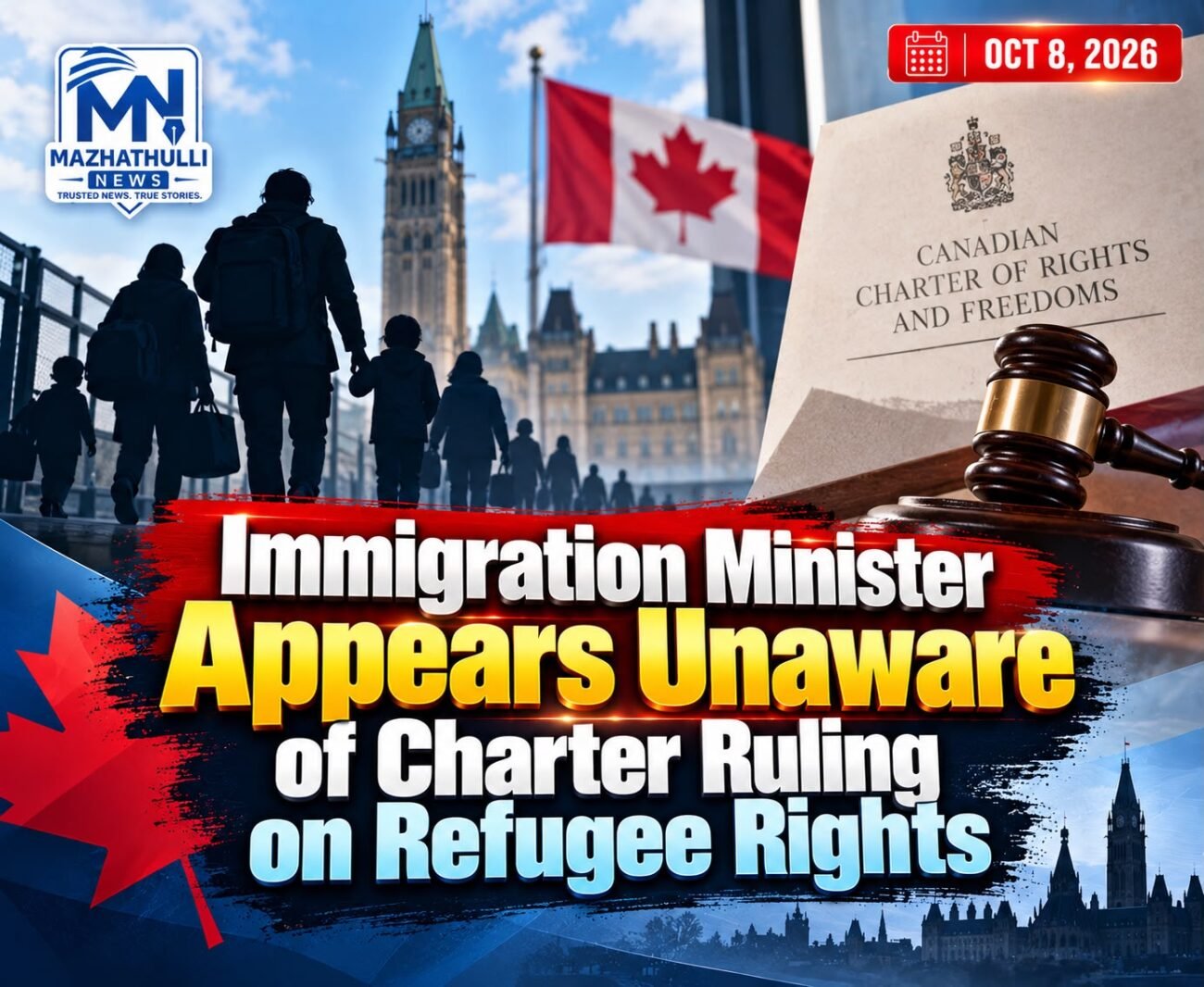
Immigration Minister Appears Unaware of Charter Ruling on Refugee Rights
Canada’s Immigration Minister Lena Metlege Diab has come under criticism after appearing unfamiliar with a landmark Supreme Court of Canada decision that established important constitutional protections for refugee claimants.
During an interview with Radio-Canada, Diab was asked about the 1985 Supreme Court ruling known as the Singh decision, which is widely regarded as a cornerstone of Canada’s refugee protection system. The decision established that refugee claimants physically present in Canada are entitled to fundamental justice under the Canadian Charter of Rights and Freedoms. When asked specifically whether she was familiar with the Singh decision, the minister appeared uncertain and asked the interviewer to repeat the name. After being told that it was the Supreme Court ruling that helped lead to the creation of the Immigration and Refugee Board of Canada, Diab responded that she understood which decision was being discussed and said she would check with her team. The exchange has drawn criticism from refugee and immigrant advocacy organizations, particularly because the Singh decision is directly relevant to ongoing debates over changes to Canada’s asylum system. The 1985 ruling involved six refugee claimants whose applications had been rejected through a process that did not provide them with an adequate opportunity to present their cases. The Supreme Court found that fundamental justice required refugee claimants to have a meaningful opportunity to know the case against them and respond to it. The decision played a major role in shaping Canada’s modern refugee determination system and ultimately contributed to the establishment of the Immigration and Refugee Board in 1989.
The issue has gained renewed attention because of Bill C-12, the federal government’s recent immigration legislation. Among other changes, the legislation introduced new restrictions affecting whether certain asylum claims can be referred to the Immigration and Refugee Board for a full hearing. One of the provisions affects people who make refugee claims more than one year after their first entry into Canada. Such claims can be prevented from being referred to the Refugee Board and instead directed toward a pre-removal risk assessment process. Another provision affects certain claims made by people who entered Canada irregularly across the Canada-U.S. land border and waited beyond the applicable time limit before making a claim. Critics argue that these restrictions could prevent some asylum seekers from receiving the type of hearing they say is protected by the principles established in Singh. The federal government, however, maintains that Bill C-12 complies with the Charter and that the Singh decision does not require an oral hearing in every refugee case. Government lawyers have argued that the Supreme Court’s ruling requires an oral hearing when credibility is at issue, rather than automatically guaranteeing such a hearing in every circumstance. Refugee advocates disagree with the government’s interpretation and say restricting access to full hearings could undermine protections established by the Supreme Court more than four decades ago.
The minister’s office later said Diab was aware of the Singh decision but suggested that the interview, conducted in French, contributed to confusion over the questions. Diab has also faced questions about the decision during appearances before parliamentary committees, where she deferred some legal questions to government officials and lawyers. The controversy comes as the federal government faces growing pressure over its approach to asylum claims, immigration levels and the backlog in Canada’s refugee determination system. Prime Minister Mark Carney has continued to support Diab as immigration minister, while refugee advocates and opposition politicians have raised concerns about her handling of the portfolio. At the centre of the dispute is a broader legal question: how far the government can go in changing the asylum process while continuing to meet the constitutional protections established by the Supreme Court’s landmark Singh ruling.