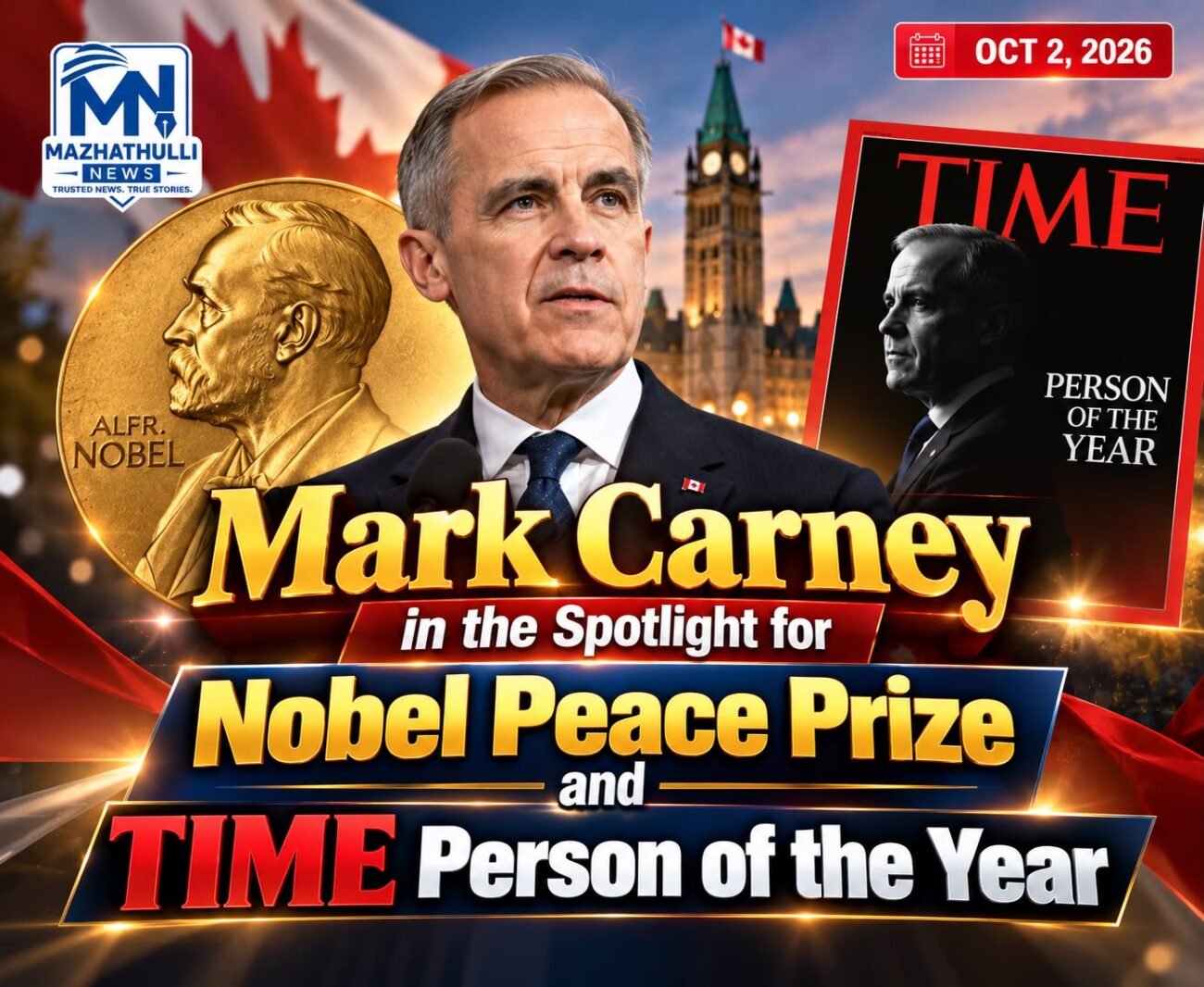
Mark Carney in the Spotlight for Nobel Peace Prize and TIME Person of the Year
Canadian Prime Minister Mark Carney is attracting growing international attention for his firm response to U.S. President Donald Trump, with speculation mounting that he could be considered for two of the world’s most prestigious honours: the Nobel Peace Prize and TIME magazine’s Person of the Year. Carney has built a stronger international profile in 2026 through his efforts to defend Canada’s sovereignty, protect its economic interests and strengthen relationships with countries beyond the United States. His approach has drawn attention at a time when trade tensions between Ottawa and Washington continue to create uncertainty for businesses, industries and workers on both sides of the border. One of the defining moments in Carney’s growing international presence came at the World Economic Forum in Davos, Switzerland, in January. Speaking to world leaders and business representatives, he argued that the traditional international order was undergoing a major transformation. He urged middle powers to work together, protect their sovereignty and develop stronger partnerships rather than depend entirely on the decisions of the world’s most powerful countries. His speech received a standing ovation and attracted widespread international attention.
Carney’s position has become particularly significant amid escalating tensions with the Trump administration. The United States has imposed tariffs on a range of Canadian products, while Canada has responded with retaliatory measures. Trump has also made repeated statements challenging Canada’s position and demanding greater alignment with American interests. Carney, however, has continued to emphasise that Canada must defend its national interests while remaining open to cooperation and negotiations.
His message has resonated with political observers and leaders in other countries concerned about the growing use of economic pressure in international relations. Carney has sought to strengthen Canada’s partnerships with European and Asian nations, expand trade opportunities and reduce the country’s heavy dependence on the American market. His recent engagement with European leaders has further increased attention on Canada’s role in the changing global landscape. The Nobel Peace Prize speculation gained momentum after Carney briefly became the leading candidate on the prediction-market platform Kalshi. Traders placed his estimated chances of winning the 2026 award at 14 per cent before the figure declined. However, these figures reflect market speculation rather than an official assessment. There is no public evidence that Carney is on the Nobel Committee’s confidential shortlist. The 2026 Nobel Peace Prize is scheduled to be announced on October 9 in Oslo, Norway.
Carney is also attracting attention in discussions surrounding TIME magazine’s Person of the Year. TIME has already included him among its 100 most influential people of 2026, recognising the growing international significance of his leadership. Prediction-market activity has placed him among the prominent names being discussed for the annual recognition. The winner is expected to be announced on December 10, although no final decision has been made.
The speculation has attracted additional interest because Trump has previously been named TIME Person of the Year twice and has publicly expressed his desire to receive the Nobel Peace Prize. The contrast between the two leaders’ international profiles has become part of the wider discussion, although both awards are determined independently and there is no confirmed connection between the speculation and Trump’s political rivalry with Carney. Carney’s international standing has also been reflected in Canada’s efforts to develop closer ties with the European Union. During a recent address to the European Parliament, he called for stronger cooperation between Canada and Europe to protect democratic values, economic resilience and the rule of law. Discussions about closer Canada-EU relations have also attracted attention from Washington, with Trump expressing opposition to proposals that could bring Canada closer to the European Union. While some commentators view Carney’s approach as an example of how a middle power can defend its interests while promoting international cooperation, others point to the economic challenges Canada continues to face because of trade tensions with the United States. The impact of tariffs, uncertainty over cross-border trade and the need to diversify export markets remain significant issues for the Canadian economy. Whether Carney ultimately receives the Nobel Peace Prize or TIME’s Person of the Year recognition remains uncertain. Nevertheless, the growing discussion surrounding both honours highlights the international attention he has attracted through his response to Trump, his emphasis on Canadian sovereignty and his calls for stronger cooperation among middle powers. For Canada, Carney’s growing global profile represents an important development at a time of significant changes in international relations. His efforts to redefine the country’s economic and diplomatic relationships have placed him at the centre of discussions about leadership, sovereignty and the future of the international order.