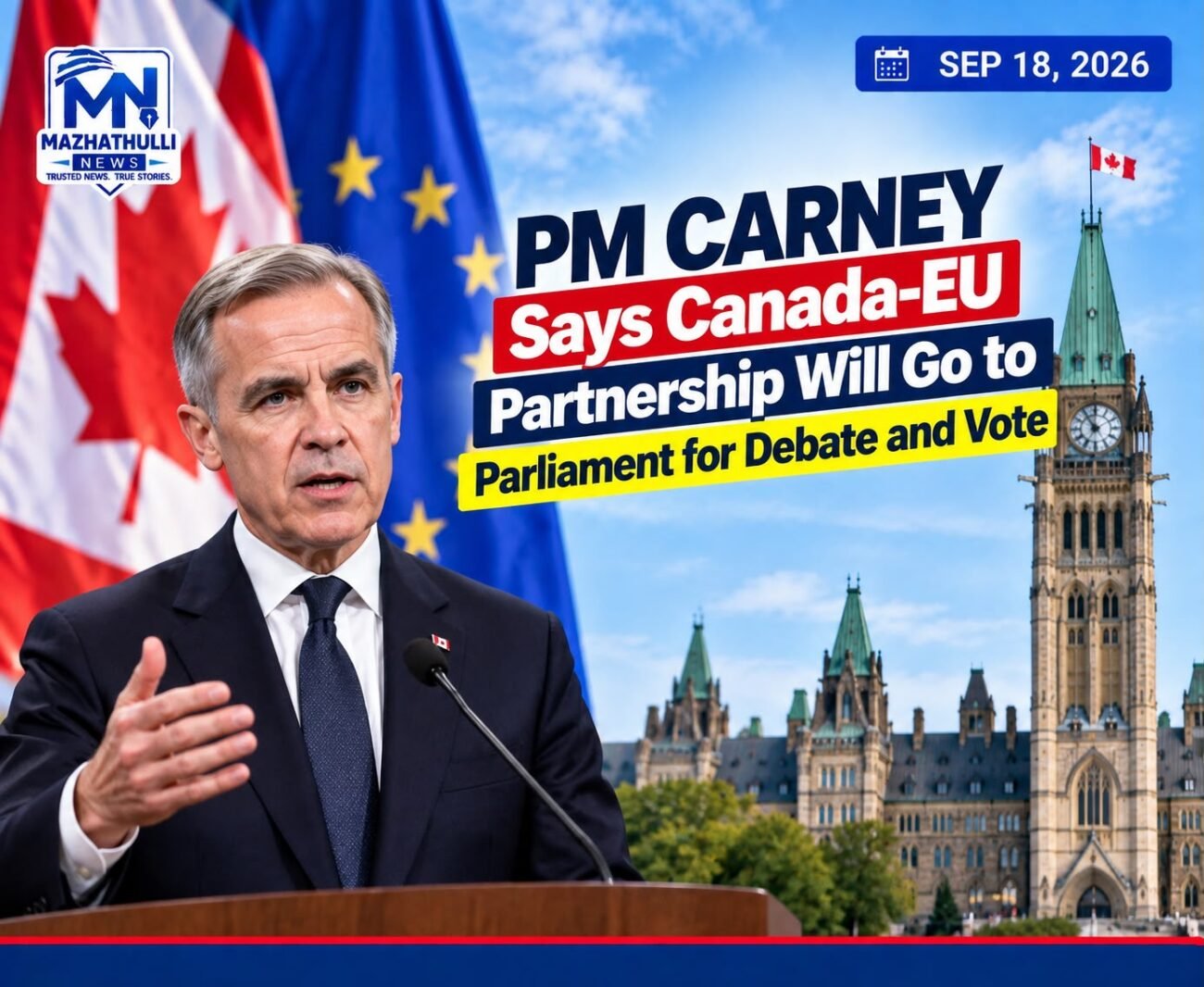
PM Carney Says Canada-EU Partnership Will Go to Parliament for Debate and Vote
Prime Minister Mark Carney says any new, enhanced partnership between Canada and the European Union will be subject to debate in the Canadian Parliament and ultimately require a final vote, as Ottawa and Brussels move toward a potentially much deeper relationship. Speaking in Strasbourg on Thursday, Carney said Canada is not seeking full membership in the European Union. Instead, the two sides are exploring a new framework that could significantly expand cooperation in areas ranging from trade and investment to defence, energy, technology and research. The proposal follows European Commission President Ursula von der Leyen’s call for Canada to become the EU’s first “associate member.” Carney welcomed the ambition for closer ties, while making clear that the precise structure and terminology of the relationship have yet to be determined. Carney said the eventual agreement will be examined through Parliament and relevant committees before Canadians’ elected representatives vote on the final structure. He also indicated that a similar parliamentary process would take place on the European side. The proposed partnership could build on the existing Canada-European Union Comprehensive Economic and Trade Agreement (CETA) and the Strategic Partnership Agreement between Canada and the EU. Ottawa and Brussels are also looking at expanding cooperation in critical minerals, artificial intelligence, quantum technology, defence procurement, energy security, financial services and research. People-to-people connections could also become part of a deeper relationship. European Parliament President Roberta Metsola raised the possibility of Canada participating in programs such as Erasmus+, which supports student exchanges, while cooperation through Horizon Europe could provide additional opportunities in research and innovation. The proposed partnership comes as Canada and Europe face a changing international economic and security environment. Carney has emphasized the importance of diversifying Canada’s international relationships and strengthening resilience through cooperation with trusted partners. He has also said that a closer relationship with Europe would not be intended to create a new geopolitical bloc. The idea has also generated debate in Canada. Some opposition politicians have raised questions about what an EU associate-member arrangement could mean for Canadian sovereignty, trade rules, immigration, taxation and domestic decision-making. However, the exact terms of the proposed status have not yet been negotiated, meaning many of those questions remain unresolved. The next major step is expected at the Canada-EU summit in Montreal on October 29 and 30, where Canadian and European leaders are expected to discuss the details of a deeper partnership and identify areas for further cooperation. For now, the proposal remains under development rather than being a finalized agreement. Any eventual arrangement would have to go through negotiations and Canada’s parliamentary process before its final structure is approved. The proposed Canada-EU partnership could therefore mark a significant expansion of the relationship between Ottawa and Brussels, but its final form, scope and legal framework will depend on negotiations in the months ahead — followed by debate and a vote in Canada’s Parliament.