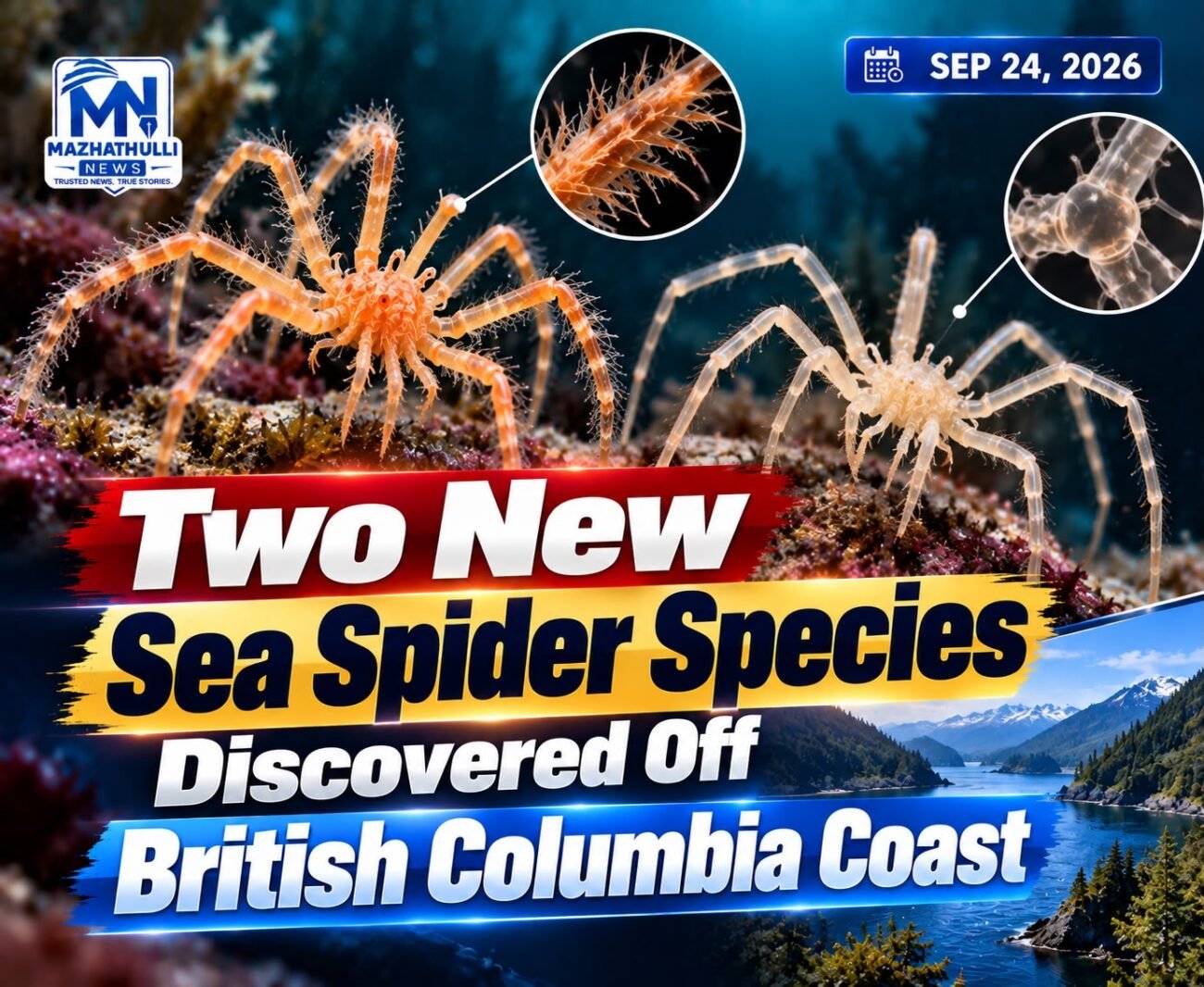
Two New Sea Spider Species Discovered Off British Columbia Coast
Researchers from the University of British Columbia have discovered two previously unknown species of sea spiders in the Salish Sea off the British Columbia coast, marking the first time in nearly a century that new sea spider species have been formally described from the region.
The newly identified species, Callipallene pilosuspedes and Tanystylum kiixin, were documented through detailed morphological examinations and genetic analysis. The research provides new information about a poorly understood group of marine animals and expands scientific knowledge of biodiversity along the B.C. coast.
The specimens were collected during research dives conducted between September 2023 and August 2024. Researchers explored several marine environments at depths of up to 18 metres, including areas around Quadra Island, Vancouver, Bamfield and Victoria. One of the newly described species, Callipallene pilosuspedes, has distinctive long, curved spines covering parts of its legs. Its name is derived from Latin words referring to its characteristic “hairy feet.” Researchers also observed that the species has red eyes, a short proboscis equipped with claws and a distinctive three-lipped mouth lined with sensory structures.
Researchers found only one specimen of Callipallene pilosuspedes during the study. Despite its tiny size, the animal has specialized appendages known as ovigers, which males use to carry eggs. The appendages can also be used for grooming, with researchers observing the animal using comb-like structures to clean its legs.
The second species, Tanystylum kiixin, was named after an ancient Indigenous village site near where the specimens were first collected. The name is pronounced “kee-hin” and refers to the sound of waves crashing at the base of the former village site. Unlike the first species, Tanystylum kiixin has smaller egg-carrying limbs and appears to have less ability to groom itself. Researchers frequently found the animals carrying dirt, debris and even tiny parasites on their bodies. The researchers described this relationship as an “ecosystem within an ecosystem,” highlighting the complex interactions that can exist even among extremely small marine organisms.
Sea spiders are not actually spiders in the traditional sense. They are marine arthropods known scientifically as pycnogonids and are found in oceans around the world. They typically live on or near the seafloor and have long, thin legs and small bodies. The animals also have unusual reproductive characteristics. Sea spiders breathe through their skin, while males are responsible for carrying and rearing the developing eggs. Females produce eggs through openings associated with their limbs, and males collect the eggs using their ovigers before attaching them to their bodies in clusters.
Some shallow-water sea spiders are also known to live in close association with larger marine organisms. Using a specialized proboscis, they can feed on fluids from organisms such as jellyfish and hydroids. The UBC research represents the first comprehensive scientific study of sea spiders in the Salish Sea combining detailed imaging with molecular genetic analysis. Researchers examined seven species in total, including five species that had previously been described and the two newly identified species.
The team also generated genetic data for several sea spider species that had never previously been genetically sequenced and developed an identification guide to help researchers distinguish species found in the Salish Sea and along the west coast of Vancouver Island. Lead researcher Cormac Toler-Scott said the research was initially motivated by questions about how marine invertebrates in the Salish Sea could be affected by climate change and human disturbance. He noted that there was limited information available about how sea spiders in the region might respond to those pressures.
The discovery also suggests that the biodiversity of the Salish Sea remains incompletely documented. Researchers say additional species could still be found as more areas are explored and more marine organisms are examined using modern genetic techniques. The two newly described species have now been formally registered in a global biodiversity database. The findings were published in the scientific journal Organisms Diversity & Evolution.
Researchers say the discovery demonstrates how much remains to be learned about even relatively well-studied coastal ecosystems. The Salish Sea supports a wide variety of marine life, and continued research could reveal additional species and provide a better understanding of how the region’s biodiversity is changing.