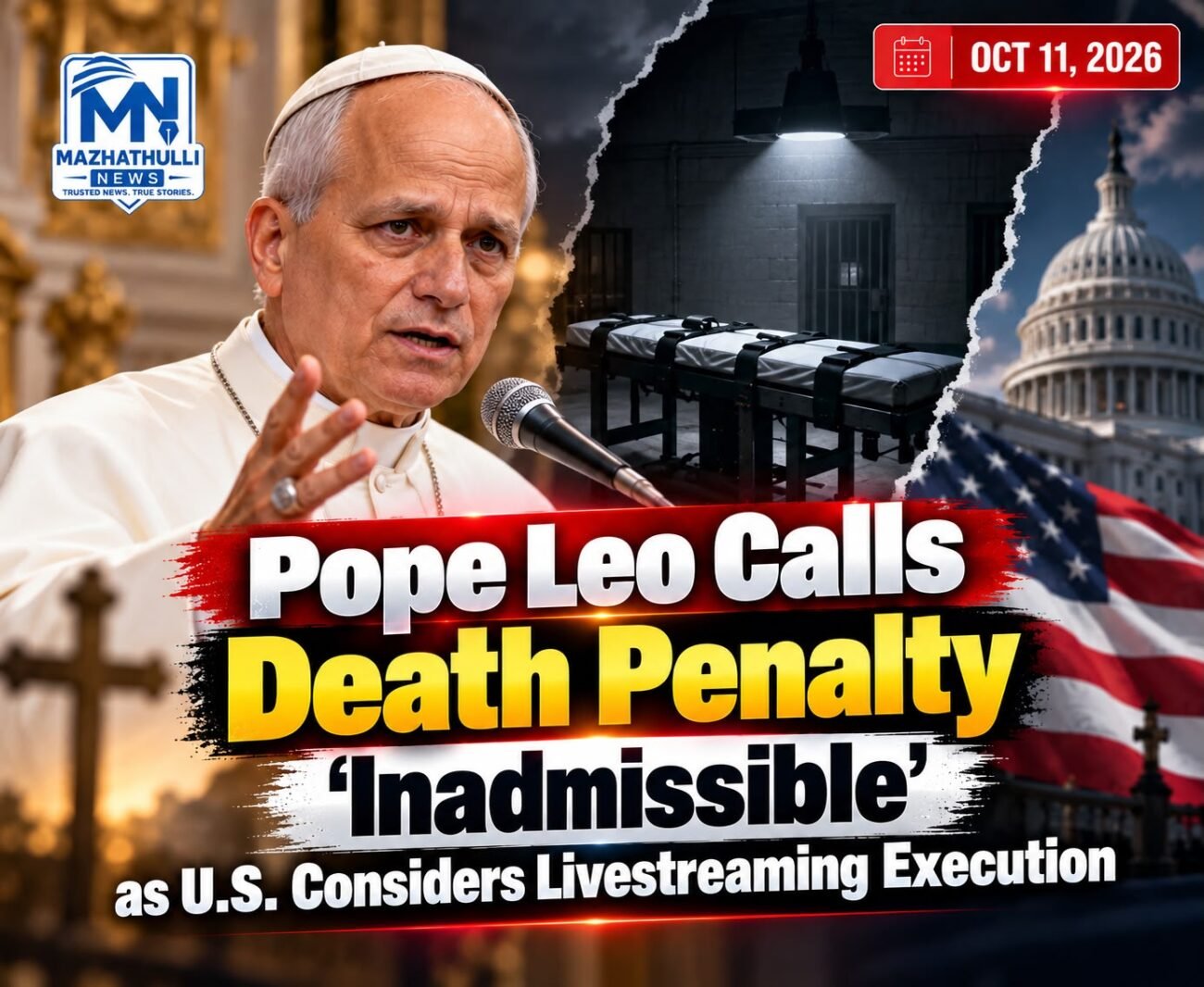
Pope Leo Calls Death Penalty ‘Inadmissible’ as U.S. Considers Livestreaming Execution
Pope Leo XIV has reaffirmed the Catholic Church’s opposition to the death penalty, declaring capital punishment “inadmissible” as the United States faces controversy over plans to livestream the execution of a convicted military shooter. The pope’s statement came on October 10, marking the World Day Against the Death Penalty, amid growing debate over human dignity, criminal justice and the public display of executions. In a message posted on his official X account, Pope Leo said the death penalty attacks the inviolability and dignity of human life. He argued that society can protect the public and uphold justice without resorting to capital punishment, stressing that effective prison systems can keep people safe while preserving the possibility of rehabilitation and redemption. “The death penalty is inadmissible because it is an attack on the inviolability and dignity of the person,” the pope wrote. He added that justice and the common good could be safeguarded through alternatives that do not involve execution. His message concluded with the hashtag #NoDeathPenalty. The statement reflects the Catholic Church’s official teaching, revised by Pope Francis in 2018 to declare the death penalty inadmissible in all circumstances. The revision emphasised the inherent dignity of every person, including those convicted of serious crimes, and the availability of modern detention systems that protect society without taking a prisoner’s life. The pope’s remarks coincided with an announcement by the U.S. Department of Defense that it planned to livestream the execution of Nidal Malik Hasan, a former U.S. Army psychiatrist convicted of carrying out the 2009 shooting at Fort Hood, Texas. Hasan killed 13 people and wounded 32 others in the attack. He was sentenced to death by a military court in 2013. The execution is scheduled for December 3, 2026, at Fort Hood and is expected to be carried out by firing squad. If it proceeds as planned, it would mark the first U.S. military execution since 1961 and the first military execution by firing squad since 1945. The proposal to broadcast the execution online has attracted criticism from religious leaders, lawmakers and human rights advocates. Pope Leo did not specifically mention Hasan or the proposed livestream in his message. However, the timing of his statement, alongside the Vatican’s explicit criticism of the broadcast plan, has brought renewed attention to the moral and legal questions surrounding public executions. Cardinal Pietro Parolin, the Vatican secretary of state and the pope’s senior diplomatic aide, directly criticised the proposal. He described the idea of livestreaming an execution as unacceptable, arguing that it would turn a person’s death into a spectacle. Parolin reiterated that the Church opposes capital punishment because it is incompatible with human dignity and, in the Church’s view, does not serve as an effective deterrent to crime. Archbishop Paul Coakley, president of the United States Conference of Catholic Bishops, also expressed shock and sorrow over the Pentagon’s plan. He said the crimes committed by Hasan could not be condoned, but argued that publicly broadcasting his execution would undermine the moral values the country should uphold. He called on the authorities to reconsider the decision. The proposal has drawn criticism from both Democrats and Republicans. Some lawmakers have argued that Hasan should face the sentence imposed by the military court but questioned whether broadcasting his death would serve any legitimate public purpose. Others have raised concerns about the precedent such a broadcast could establish and whether it would contribute to public understanding of the justice system.
U.S. President Donald Trump has supported Hasan’s execution by firing squad but has said he will make the final decision on whether the event should be livestreamed. Vice-President JD Vance has also expressed reservations about the broadcast, saying he would not watch it and questioning whether the plan would ultimately proceed. The controversy has emerged amid renewed scrutiny of capital punishment in the United States following a botched lethal-injection attempt in Tennessee involving Christa Pike. The incident has intensified debate over execution procedures, the treatment of prisoners and the risks associated with methods intended to carry out death sentences.
The proposed livestream also raises questions about the balance between government transparency and the dignity of the condemned person, as well as the potential impact on victims’ families. Supporters of the broadcast may argue that the public should see the consequences of serious crimes, while critics say showing an execution live risks turning punishment into entertainment without improving public safety. Pope Leo, the first American-born pope, has repeatedly emphasised the importance of prison ministry and the possibility of redemption for people who have committed crimes. His message reinforces the Church’s position that protecting society does not require the state to take a person’s life, regardless of the seriousness of the offence.
As the December execution date approaches, the final decision on the proposed livestream remains uncertain. The debate has exposed a wider divide over capital punishment in American society, with religious leaders and human rights advocates urging officials to reconsider the broadcast and renew attention to alternatives that protect the public while respecting human dignity.