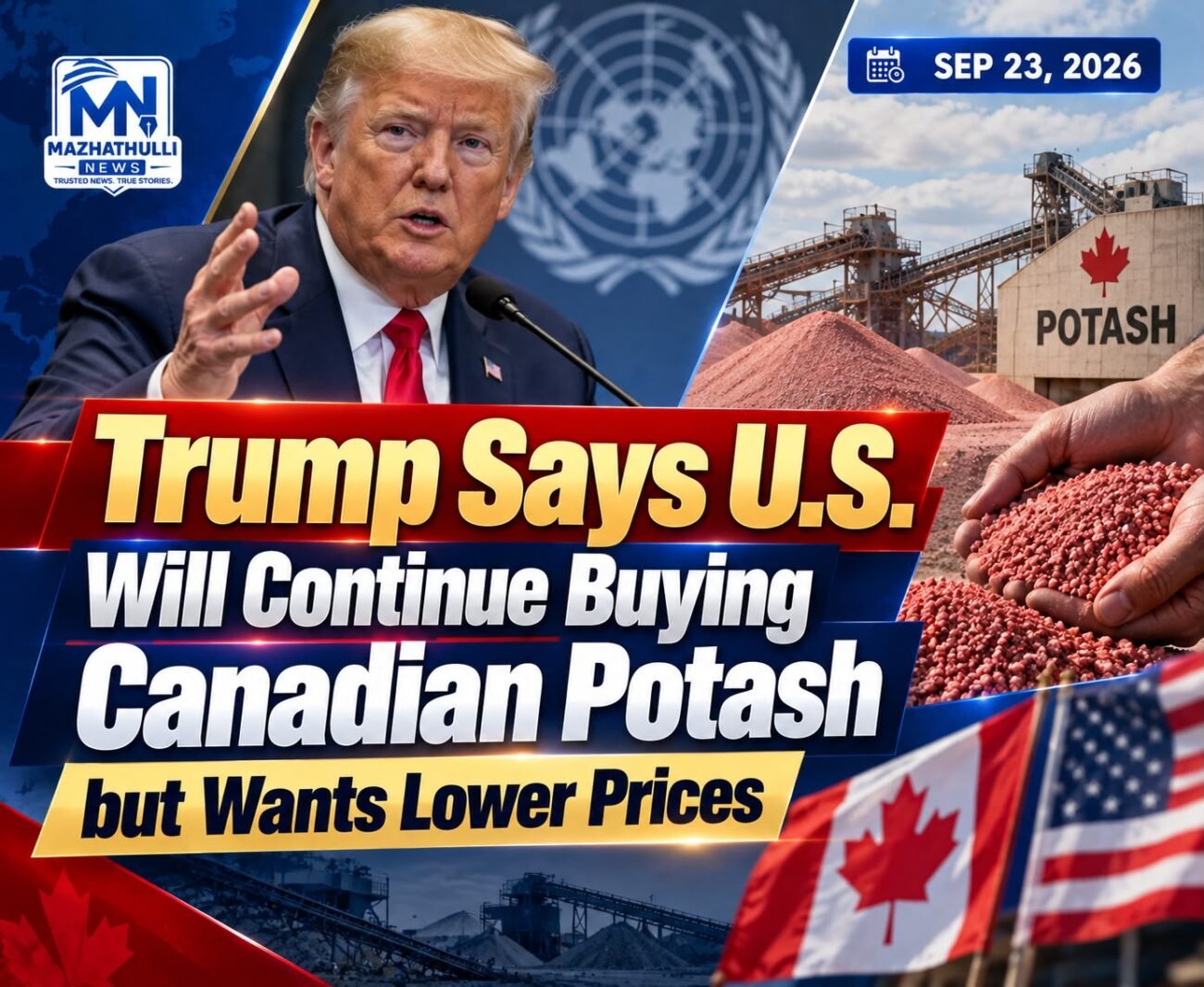
Trump Says U.S. Will Continue Buying Canadian Potash but Wants Lower Prices
U.S. President Donald Trump says the United States will continue purchasing potash from Canada, while also seeking lower prices for the fertilizer ingredient as his administration explores alternative suppliers, including Belarus. Trump made the comments Tuesday during a bilateral meeting with Ukrainian President Volodymyr Zelenskyy on the sidelines of the United Nations General Assembly in New York. His remarks came one day after he said the United States was working on a deal to purchase Belarusian potash at a price substantially below what it currently pays for Canadian supplies.
“Belarus has a lot of potash, and our farmers need good prices, and we want to get a lower price,” Trump told reporters when asked about the potential Belarus deal. “We’ll continue to go with Canada, but Belarus would like to sell it for a much lower price,” he said.
The comments appear to leave Canada as a major supplier to the U.S. market while giving Washington another potential source of fertilizer. The United States relies heavily on Canadian potash, and Saskatchewan is the world’s largest producer of the mineral. Potash is a key ingredient in agricultural fertilizer. It provides potassium that helps plants with growth, crop quality and resistance to disease and drought-related stress. Because of its importance to agricultural production, reliable access to potash is an important issue for farmers and fertilizer markets. According to U.S. Geological Survey data cited by Global News, Canada accounts for about 79 per cent of U.S. potash imports. Russia is the second-largest supplier at about 11 per cent, while Belarus accounts for roughly three per cent.
All of Canada’s potash is produced in Saskatchewan, making the U.S. market particularly important to the province’s mining industry. Canadian producers also benefit from geographic proximity and established transportation infrastructure connecting Saskatchewan production to American agricultural markets.
Trump’s comments followed his announcement Monday that Washington was working on a “massive” deal to purchase potash from Belarus at a lower price than the United States currently pays Canada. Trump described the potential savings as positive for American farmers and ranchers.
The proposal has raised questions about how much Belarusian potash could realistically reach the U.S. market. Belarus is landlocked and would require transportation through complex international supply routes before reaching American buyers. Industry analysts have also questioned whether Belarus has sufficient additional production capacity to significantly increase exports to the United States.
Fertilizer analyst Josh Linville of StoneX said the potential impact of additional Belarusian supply could be limited. He said the U.S. has not faced a shortage of potash and suggested that American agriculture is experiencing greater concerns with other fertilizer nutrients, including nitrogen and phosphate. Belarusian President Alexander Lukashenko has also said his country would not be able to supply the United States with large volumes of potash. Belarusian potash exports have faced significant logistical and sanctions-related challenges in recent years.
The possibility of increased Belarusian imports has also generated a political response in Saskatchewan. Premier Scott Moe criticized Trump’s initial proposal to purchase Belarusian potash, pointing to Belarus’s support for Russia and the sanctions imposed on the country by Canada and its allies. Canadian Prime Minister Mark Carney, meanwhile, said Canada remains prepared to supply the United States with potash. Asked about Trump’s latest comments, Carney described Canadian potash as reliable and cost-effective and said there was an opportunity for Canada and the United States to expand cooperation in the fertilizer sector.
The issue is also connected to broader Canada-U.S. trade tensions. The United States and Canada have been involved in continuing disputes over tariffs and trade policy, with agricultural products and industrial goods among the areas affected by changing trade measures. For Canadian potash producers, the U.S. remains a critical market. The emergence of another potential supplier could nevertheless add pressure to pricing negotiations, particularly if Washington seeks to use competition among international suppliers to reduce fertilizer costs for American farmers. For U.S. farmers, lower fertilizer prices could reduce some production costs if alternative supplies become available at competitive prices. However, analysts have questioned whether Belarus can overcome the transportation, production and logistical challenges required to become a major supplier to the American market.
For now, Trump says the United States will continue buying Canadian potash while exploring whether Belarus can provide additional supplies at a lower price. The outcome of those discussions could have implications for fertilizer prices, Saskatchewan’s potash industry and the broader Canada-U.S. agricultural trade relationship.