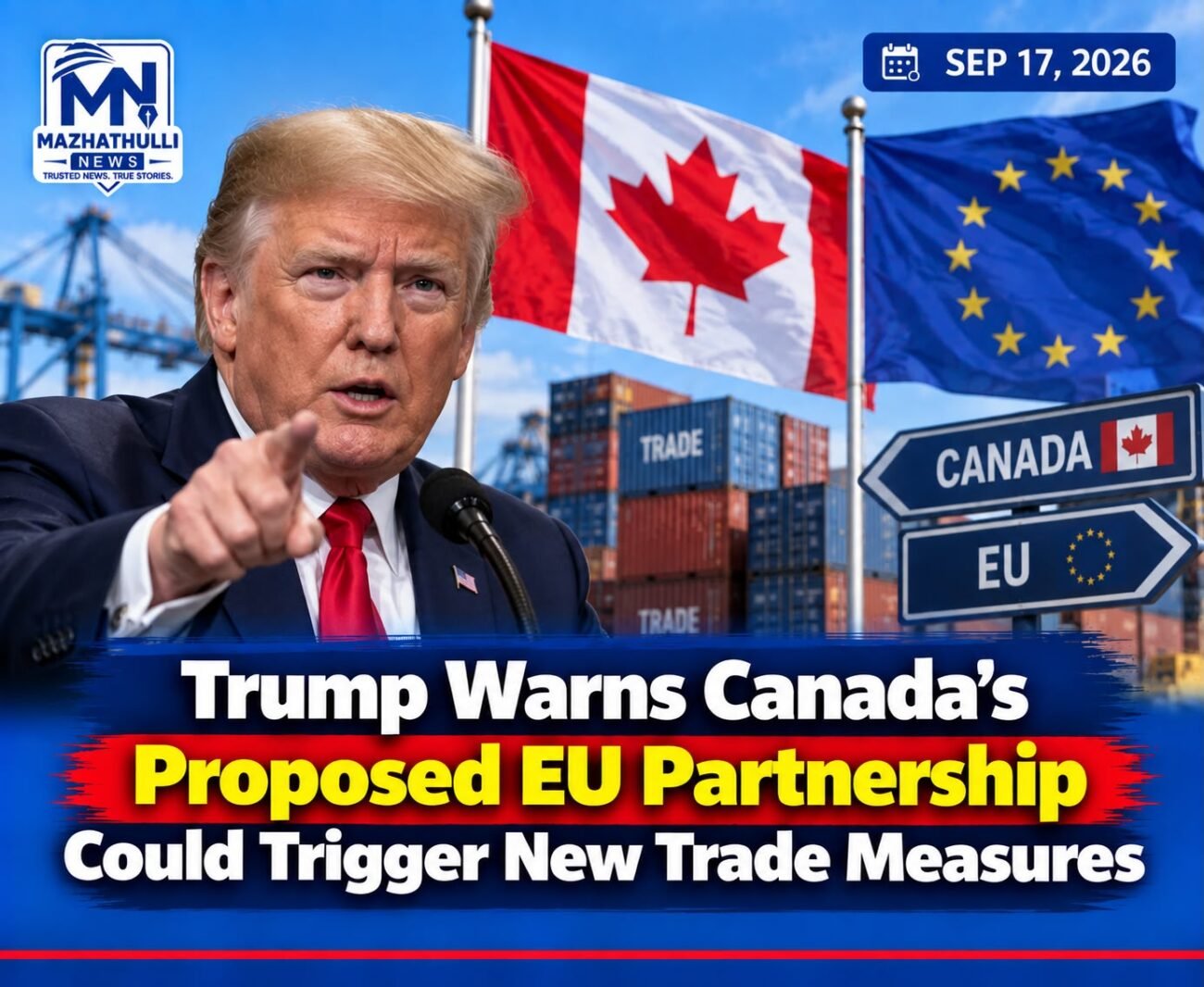
Trump Warns Canada’s Proposed EU Partnership Could Trigger New Trade Measures
U.S. President Donald Trump has warned that Canada becoming an associate member of the European Union could be considered a “hostile act” toward the United States, raising concerns about a possible further escalation in trade tensions. Speaking to reporters after arriving in North Carolina on Wednesday, Trump said Washington could impose “very serious tariffs” on Europe or stop trading with certain European sectors if Canada’s closer relationship with the EU were pursued with what he described as “bad intentions.” He did not announce any immediate action or specify a tariff rate. Trump also criticized Canada’s trade relationship with the United States, describing Canada as a “terrible trade partner.” Earlier in the day, he signed a memorandum directing U.S. federal agencies responsible for government procurement to remove Canadian-origin products from certain purchasing processes. A White House official said that order was separate from the European Union’s proposal to strengthen ties with Canada. The warning came after European Commission President Ursula von der Leyen proposed opening the way for Canada to become the EU’s first associate member. She made the proposal during her annual State of the Union address to the European Parliament in Strasbourg, with Canadian Prime Minister Mark Carney attending. Von der Leyen said the EU wanted to bring its relationship with Canada to the highest possible level through an “Alliance for the Future.” The proposed cooperation could include trade, defence, energy, technology, critical minerals, manufacturing and Arctic security. The proposal is still at an early stage, and the exact meaning of “associate membership” has not been defined. Unlike full EU membership, the proposed status would require a separate legal and political framework setting out the rights, responsibilities and areas of cooperation available to Canada.
Canada and the EU already have a trade agreement known as the Comprehensive Economic and Trade Agreement, or CETA. A broader partnership could build on that framework by expanding cooperation in strategic industries, defence procurement, technology regulation, energy security and critical-mineral supply chains. The initiative comes as Canada seeks to diversify its international relationships amid continuing trade disputes with Washington. Ottawa has been pursuing closer ties with Europe and other partners to reduce its reliance on the U.S. market and create additional opportunities for Canadian exporters. The proposed partnership could provide Canada with stronger access to European investment, research networks and industrial cooperation. It could also support joint efforts in areas such as artificial intelligence, clean technology, defence manufacturing and the development of critical minerals needed for modern industries. However, significant questions remain. Negotiators would need to determine whether associate membership would provide broader access to the EU single market, which regulations Canada might adopt and whether the arrangement would affect trade rules, investment or the movement of people and services. European officials have not indicated that the proposal is intended to undermine the United States. The initiative has instead been presented as an effort to strengthen cooperation among democratic partners facing common economic and security challenges.
Trump’s comments nevertheless add a diplomatic complication to the discussions. If Washington were to impose new tariffs on European goods, Canadian companies connected to European supply chains could face indirect effects through higher costs, changing trade routes and increased uncertainty.
Further discussions are expected before any formal agreement is developed. Canada and the EU are expected to examine the proposal at an upcoming summit in Montreal, where leaders could discuss the structure of the partnership and identify practical areas for closer cooperation. For now, no formal associate-membership agreement has been reached, and no U.S. retaliatory measures have been announced. The future of the proposal will depend on negotiations between Canada and the EU, as well as the broader direction of Canada-U.S. trade relations.